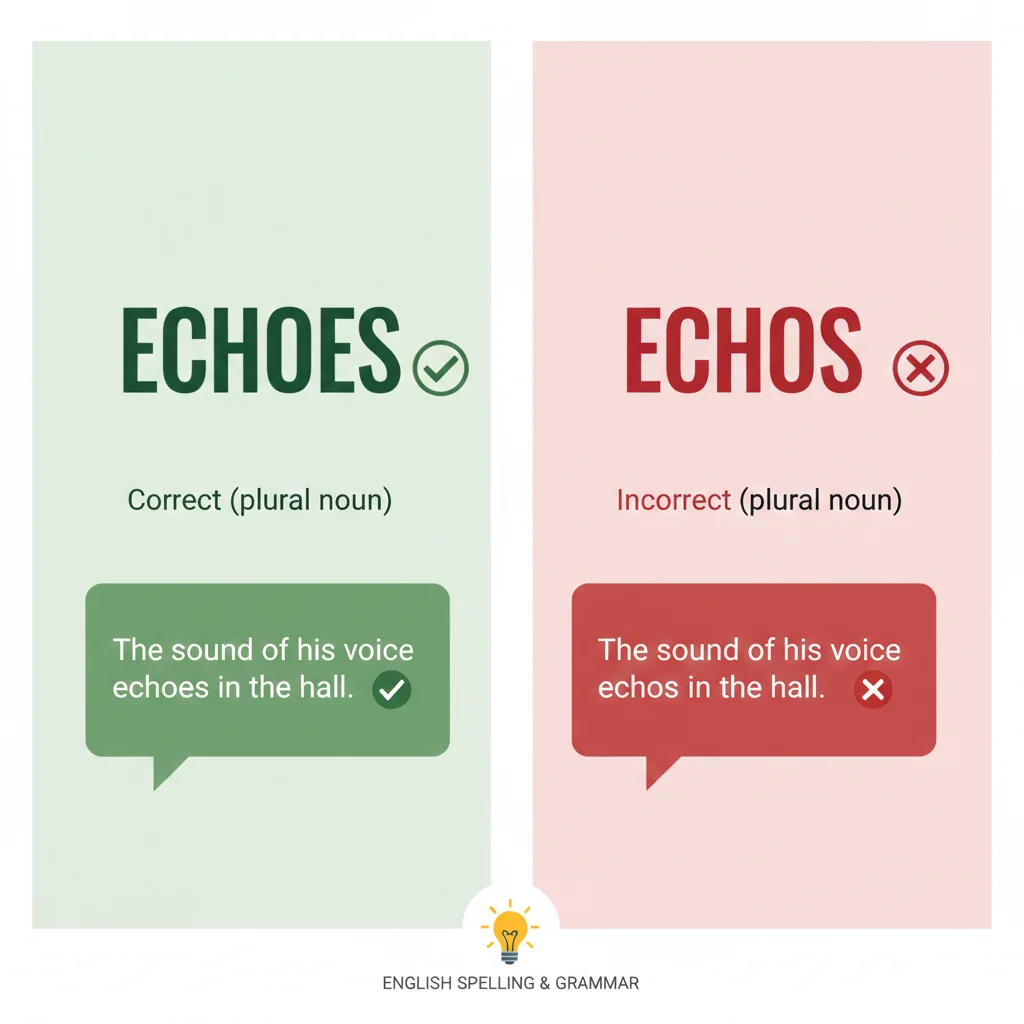
Have you ever written a sentence like, “Her voice echos through the hall,” and then wondered if it should be echos or echoes? You’re not alone. Many English learners — and even native speakers — get confused about these two spellings.
The good news? Only one of them is correct in modern English.
In this complete guide, you’ll learn:
- What echoes and echos mean
- Which one is correct and why
- How to use the correct word in real-life sentences
- Easy memory tricks
- Common mistakes and how to avoid them
By the end, you’ll feel confident using the right spelling — even if English spelling usually feels tricky. Let’s make it simple and fun 😊
What Does Each Word Mean?
Let’s look at both spellings clearly and simply.
✅ Echoes
Echoes is the correct spelling in modern English.
It can be:
- A noun (a sound that repeats)
- A verb (when a sound repeats)
Meaning (in easy words):
An echo is when a sound comes back to you after bouncing off something, like a wall or mountain.
Examples (Noun):
- The echoes of laughter filled the hallway.
- We heard echoes in the empty cave.
- Her words left echoes in my mind.
Examples (Verb):
- His voice echoes across the field.
- The shout echoes in the tunnel.
- Her message echoes what we all feel.

❌ Echos
Echos is an outdated and incorrect spelling in modern English.
You might see it:
- In very old books
- In informal or mistaken writing
- In learner mistakes
But in today’s English:
👉 Echos = wrong
👉 Echoes = correct
There is no situation where echos is the preferred spelling now.
The Key Difference Between Echoes and Echos
Here’s a simple comparison table to make it crystal clear:
| Feature | Echoes | Echos |
|---|---|---|
| Is it correct? | ✅ Yes | ❌ No |
| Used in modern English? | ✅ Always | ❌ Never |
| Part of speech | Noun & Verb | None |
| Example | Her voice echoes loudly. | ❌ Her voice echos loudly. |
⭐ Quick Tip:
If you’re ever unsure, remember:
Echoes has -oes, just like goes and does.
Common Mistakes and How to Avoid Them
Let’s look at mistakes people often make — and how to fix them.
❌ Mistake 1:
Her voice echos in the hallway.
✅ Correct:
Her voice echoes in the hallway.
Why this happens:
People think the plural or third-person form should just add -s, but echo follows a spelling rule that adds -es.
❌ Mistake 2:
The cave was full of strange echos.
✅ Correct:
The cave was full of strange echoes.
Why this happens:
Some words ending in -o add -es instead of -s when plural.
❌ Mistake 3:
His words echos in my mind.
✅ Correct:
His words echoes in my mind.
Why this happens:
Writers forget that verbs also need -es in the third-person singular (he/she/it).
🛠 How to Avoid These Mistakes:
- Always use echoes
- Never use echos
- Remember: If it sounds like “goes,” spell it like “goes”
When to Use “Echoes”

You should use echoes whenever:
- A sound repeats
- A voice carries far
- A feeling or idea repeats
- Someone copies another person’s words or thoughts
Let’s see real-life examples.
🔊 Sound Examples:
- The bell echoes across the school yard.
- Her laugh echoes in the empty room.
- Our footsteps echoes in the hallway.
🧠 Idea or Feeling Examples:
- His story echoes my own experience.
- Her words echoes what everyone feels.
🏫 School or Daily Life Examples:
- The teacher’s voice echoes in the classroom.
- The gym echoes with cheering.
- His name echoes through the stadium.
When to Use “Echos”
Here’s the simple truth:
👉 Never use “echos” in modern English.
It is:
- Outdated
- Incorrect
- Not accepted in proper writing
🧠 Memory Hack:
If you see echos, think:
“This word is missing its E — just like it’s missing correctness!”
Stick with echoes, and you’ll always be right.
Why Does “Echo” Become “Echoes”? (Simple Grammar Rule)
Some English words ending in -o add -es instead of just -s.
Examples:
- Go → Goes
- Do → Does
- Echo → Echoes
- Hero → Heroes
- Potato → Potatoes
So:
- One echo → Two echoes
- He echo → He echoes
This rule helps your spelling look natural and correct.
Quick Recap: Echoes vs Echos
Let’s summarize everything in a super simple way:
- ✅ Echoes = Correct spelling
- ❌ Echos = Incorrect spelling
- Echoes works as:
- A noun → The echoes were loud.
- A verb → Her voice echoes.
💡 Always choose echoes — no exceptions.
Advanced Tips (Optional)
📜 Word History:
The word echo comes from Greek mythology. Echo was a nymph who could only repeat what others said. Over time, her name became the word we use today for repeating sounds.
📝 In Formal Writing:
In essays, stories, or exams, always use echoes:
- The poem echoes the writer’s sadness.
- His speech echoes hope and unity.
📱 In Texting or Online Writing:
Even in casual messages, using echoes makes your English look clean and correct.
Mini Quiz: Test Yourself
Fill in the blanks with the correct word.
- Her voice ______ through the empty hall.
- The cave was full of strange ______.
- His message ______ what we all believe.
- Our footsteps ______ in the tunnel.
- The teacher’s voice ______ across the classroom.
- The old building ______ with memories.
- His words still ______ in my mind.
✅ Answers:
- echoes
- echoes
- echoes
- echoes
- echoes
- echoes
- echoes
(See? One word solves everything 😄)
FAQs
❓1. Is “echos” ever correct?
No. Echos is not correct in modern English. Always use echoes.
❓2. Why does “echo” change to “echoes”?
Because many words ending in -o add -es in plural and verb forms.
❓3. Can “echoes” be both a noun and a verb?
Yes!
- Noun: The echoes were loud.
- Verb: Her voice echoes.
❓4. Is “echoed” spelled the same way?
Yes. The past tense is echoed, not echoesed or echosed.
❓5. How can I remember the correct spelling?
Think:
Echo goes → Echoes goes.
If go becomes goes, then echo becomes echoes.
Conclusion
Now you know the full truth about echoes and echos. Only echoes is correct in modern English. It works as both a noun and a verb, and it follows a common spelling rule for words ending in -o.
Whenever you hear a sound bounce back, read repeating ideas, or write about voices carrying far — use echoes with confidence. With just this one small spelling fix, your writing becomes clearer and more professional.
Keep practicing, keep reading, and keep improving your English — one word at a time 🌟
Elizabeth Gaskell was a Victorian English novelist and biographer, celebrated for social realism, strong female characters, and industrial age themes. era life.