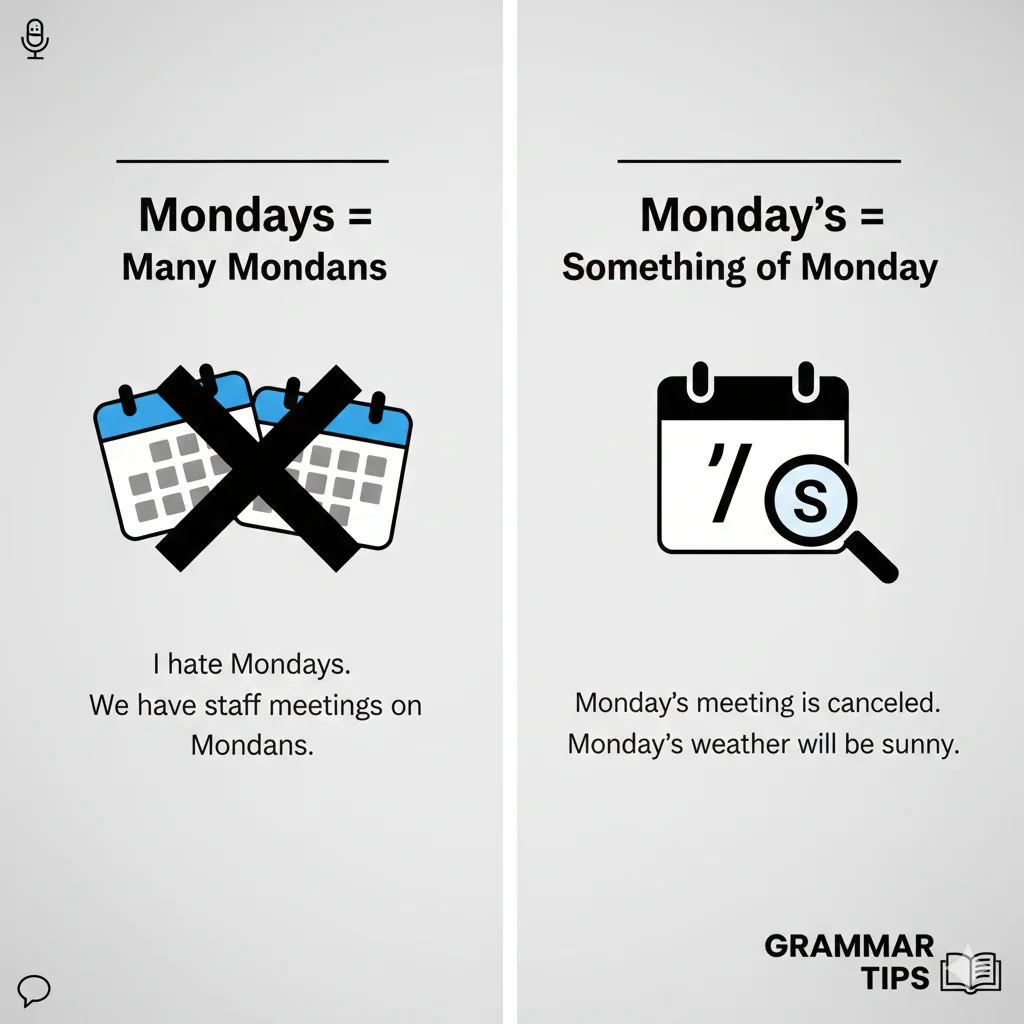
Many English learners and writers often get confused between “Mondays” and “Monday’s.” Although these words sound similar, they have different grammatical uses. Using the wrong form can change the meaning of a sentence and make your writing appear unclear or unprofessional. Knowing the correct usage ensures that your writing is accurate and easy to understand.
The word “Mondays” is the plural form of Monday, referring to more than one Monday. For example: “I have meetings every Monday and Wednesday, but I especially dislike Mondays.” In contrast, “Monday’s” is the possessive form, indicating that something belongs to a specific Monday. For instance: “Monday’s schedule is packed with appointments.” The apostrophe in “Monday’s” shows ownership, which is why it is different from the plural form.
Understanding the difference between Mondays and Monday’s helps you avoid common grammar mistakes and makes your writing more professional. When you use the correct form, your sentences become clearer, more polished, and easier for readers to understand, improving the overall quality of your content.
What Does Each Word Mean?
✅ What Does Mondays Mean?
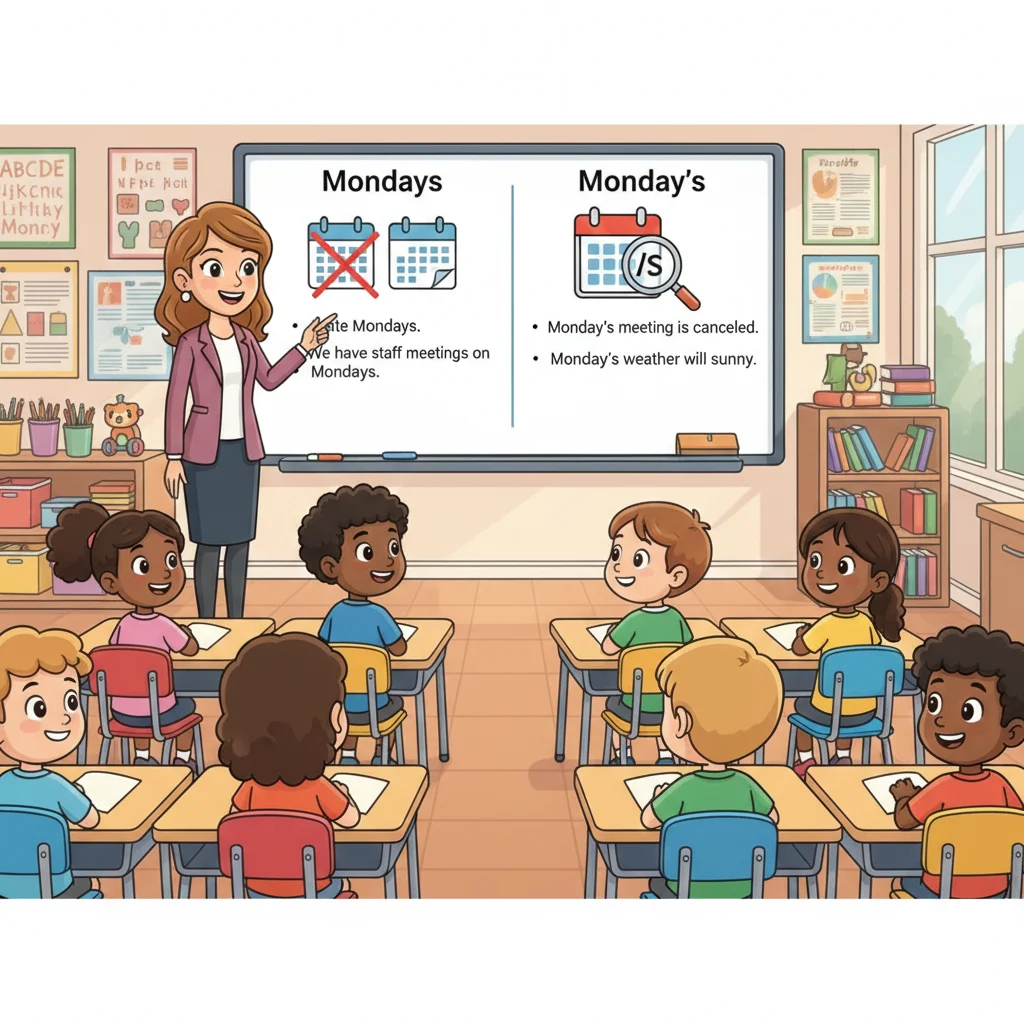
Mondays is the plural form of Monday.
It means more than one Monday.
Part of speech: Noun (plural)
Easy Examples:
- I go to school early on Mondays.
- We have football practice on Mondays and Thursdays.
- Mondays can feel sleepy after the weekend.
👉 Think of it like this:
If you can replace it with “many Mondays,” then Mondays is correct.
✅ What Does Monday’s Mean?
Monday’s is the possessive form of Monday.
It shows that something belongs to Monday.
Part of speech: Noun (possessive)
Easy Examples:
- Monday’s homework is very easy.
- I missed Monday’s class.
- Monday’s weather was rainy.
👉 Think of it like this:
If you can say “something of Monday,” then Monday’s is correct.
The Key Difference Between Mondays and Monday’s
Here’s a simple table to make it clear:
| Word | Meaning | Used For | Example |
|---|---|---|---|
| Mondays | More than one Monday | Plural | I work on Mondays. |
| Monday’s | Something belonging to Monday | Possession/Ownership | Monday’s test was easy. |
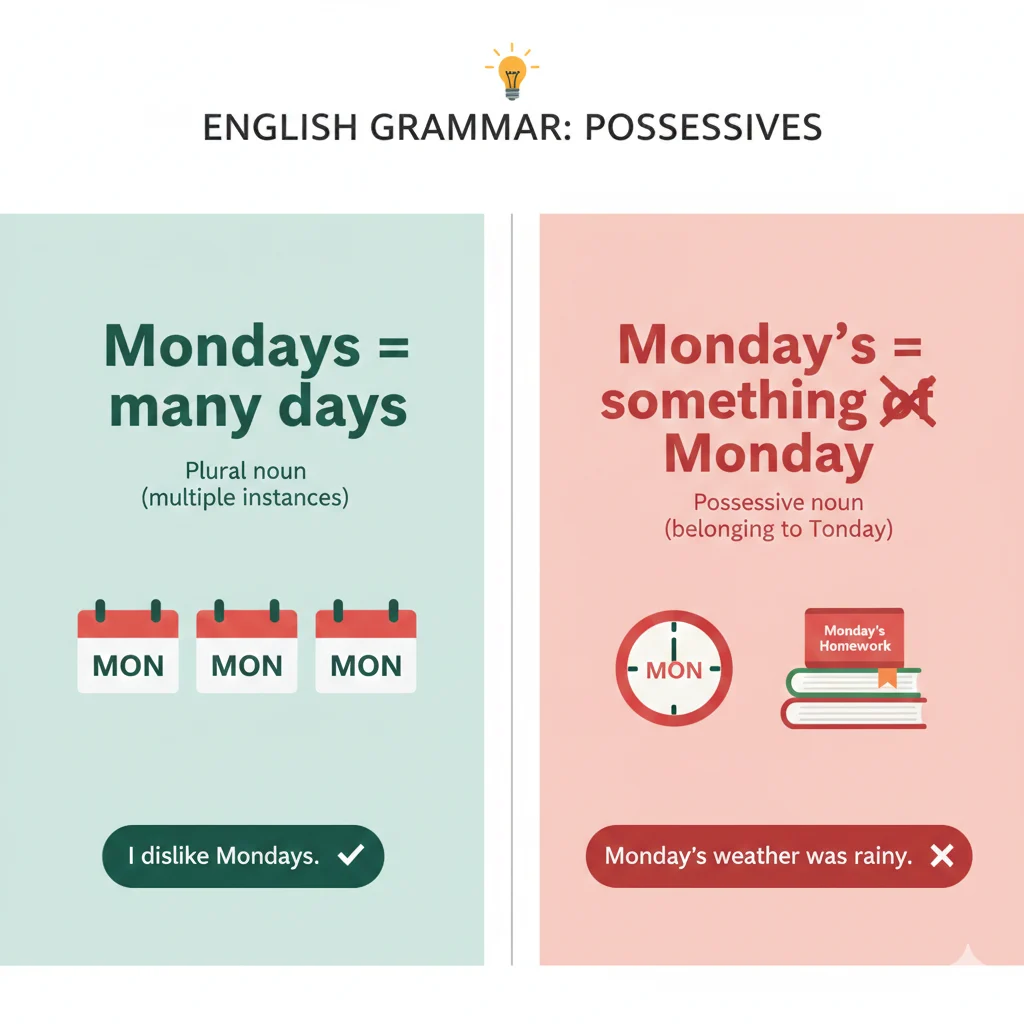
- If you mean many days, use Mondays.
- If you mean something of the day, use Monday’s.
Common Mistakes and How to Avoid Them
Let’s look at mistakes people often make and fix them.
❌ Mistake 1:
I hate Monday’s.
✅ Correct:
I hate Mondays.
🧠 Why?
You are talking about many Mondays, not something belonging to Monday.
❌ Mistake 2:
Mondays homework is hard.
✅ Correct:
Monday’s homework is hard.
🧠 Why?
The homework belongs to Monday, so you need an apostrophe.
❌ Mistake 3:
She has exams on Monday’s and Tuesdays.
✅ Correct:
She has exams on Mondays and Tuesdays.
🧠 Why?
You are listing days in plural form, not ownership.
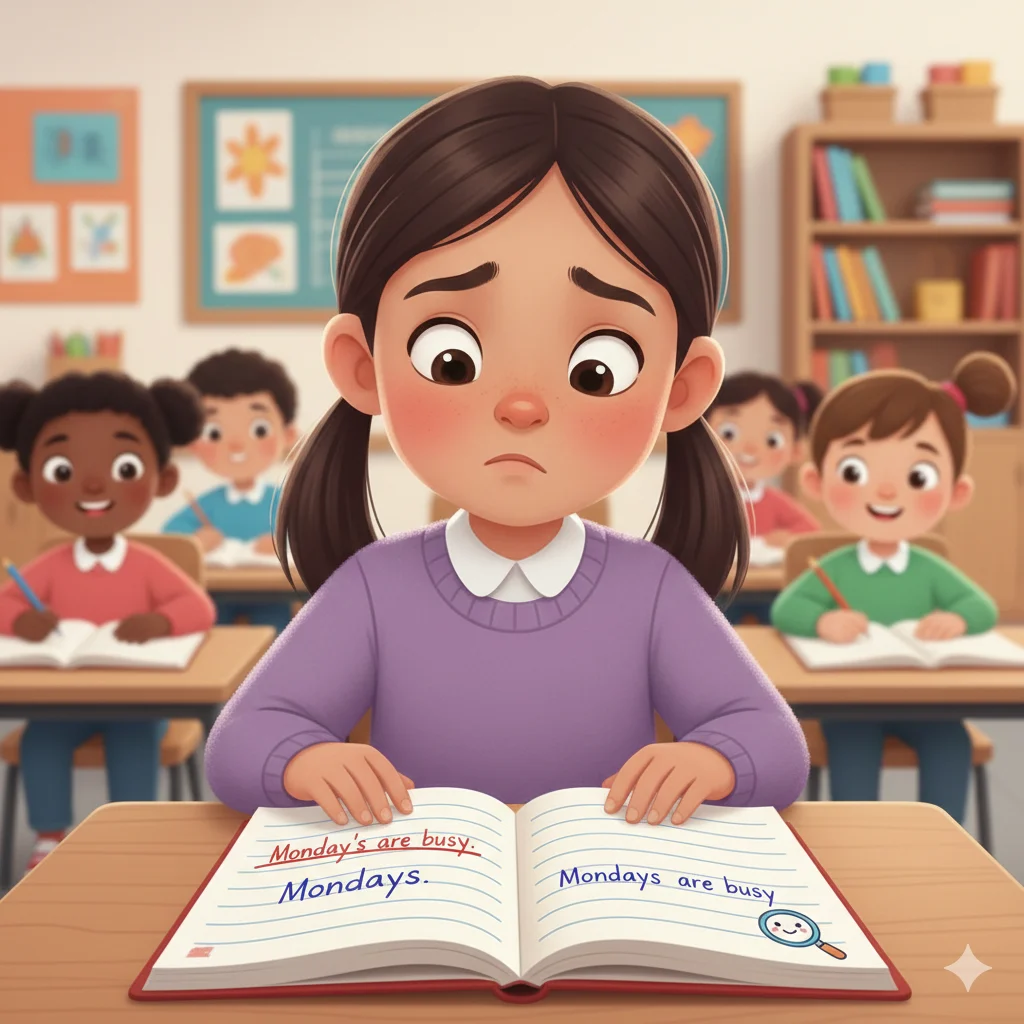
When to Use Mondays
Use Mondays when talking about:
✔ More than one Monday
✔ Weekly habits
✔ Schedules
✔ Routines
Easy Examples:
- I go to tuition on Mondays.
- We wear uniforms on Mondays.
- My dad works late on Mondays.
- The shop is closed on Mondays.
- Mondays are busy at school.
👉 Real-life tip:
If you can say “every Monday” or “many Mondays,” use Mondays.
When to Use Monday’s
Use Monday’s when talking about:
✔ Something that belongs to Monday
✔ Events on a specific Monday
✔ Things connected to that day
Easy Examples:
- Monday’s exam was very easy.
- I forgot Monday’s lunch box.
- Monday’s match was exciting.
- We discussed Monday’s lesson today.
- Monday’s weather was very hot.
🧠 Memory Trick:
If you can add “of Monday”, use Monday’s.
Example:
“Homework of Monday” → Monday’s homework ✅
Quick Recap: Mondays vs Monday’s
- Mondays → More than one Monday
✔ I wake up early on Mondays. - Monday’s → Something belongs to Monday
✔ Monday’s test was easy.
⭐ Remember:
- No apostrophe = plural
- Apostrophe + s = ownership
Advanced Tips (Optional)
📜 History Tip:
The word Monday comes from “Moon’s Day” in old English, named after the moon. Over time, it became Monday.
📝 In School and Exams:
Teachers expect correct apostrophe use. Writing Monday’s instead of Mondays can lower your marks because it changes the meaning.
💬 In Texting and Online Writing:
Many people skip apostrophes in chats. But in formal writing, essays, and emails, using Mondays and Monday’s correctly shows strong English skills.
Mini Quiz: Test Yourself ✏️
Fill in the blanks with Mondays or Monday’s:
- I have swimming class on ______.
- ______ homework was very easy.
- She feels tired on ______.
- ______ weather was cold.
- The shop closes early on ______.
- I missed ______ lesson.
- We wear sports shoes on ______.
✅ Answers:
- Mondays
- Monday’s
- Mondays
- Monday’s
- Mondays
- Monday’s
- Mondays
Great job if you got most right! 🎉
FAQs
1. Is it correct to write “I hate Monday’s”?
❌ No.
✅ Correct: “I hate Mondays” because you mean more than one Monday.
2. When should I use Monday’s with an apostrophe?
Use Monday’s when something belongs to Monday, like Monday’s test or Monday’s homework.
3. Can Mondays ever have an apostrophe?
No. Apostrophes are not used to make words plural. Mondays never needs an apostrophe.
4. What is the easiest way to remember the difference?
If it means many days, use Mondays.
If it means something of the day, use Monday’s.
5. Is “Mondays homework” correct?
❌ No.
✅ Correct: Monday’s homework because the homework belongs to Monday.
Conclusion
Now you know the clear difference between Mondays and Monday’s. One talks about more than one day, and the other shows ownership or belonging. That small apostrophe makes a big difference, but with the tips, examples, and memory tricks in this guide, you’ll never get confused again.
Keep practicing in your writing, schoolwork, and messages. The more you use correct grammar, the stronger your English becomes — one sentence at a time 🌟

Dorothy Whipple was an English novelist and short story writer, famed for emotional realism, domestic themes, and sharp insight into women’s lives. worldwide UK