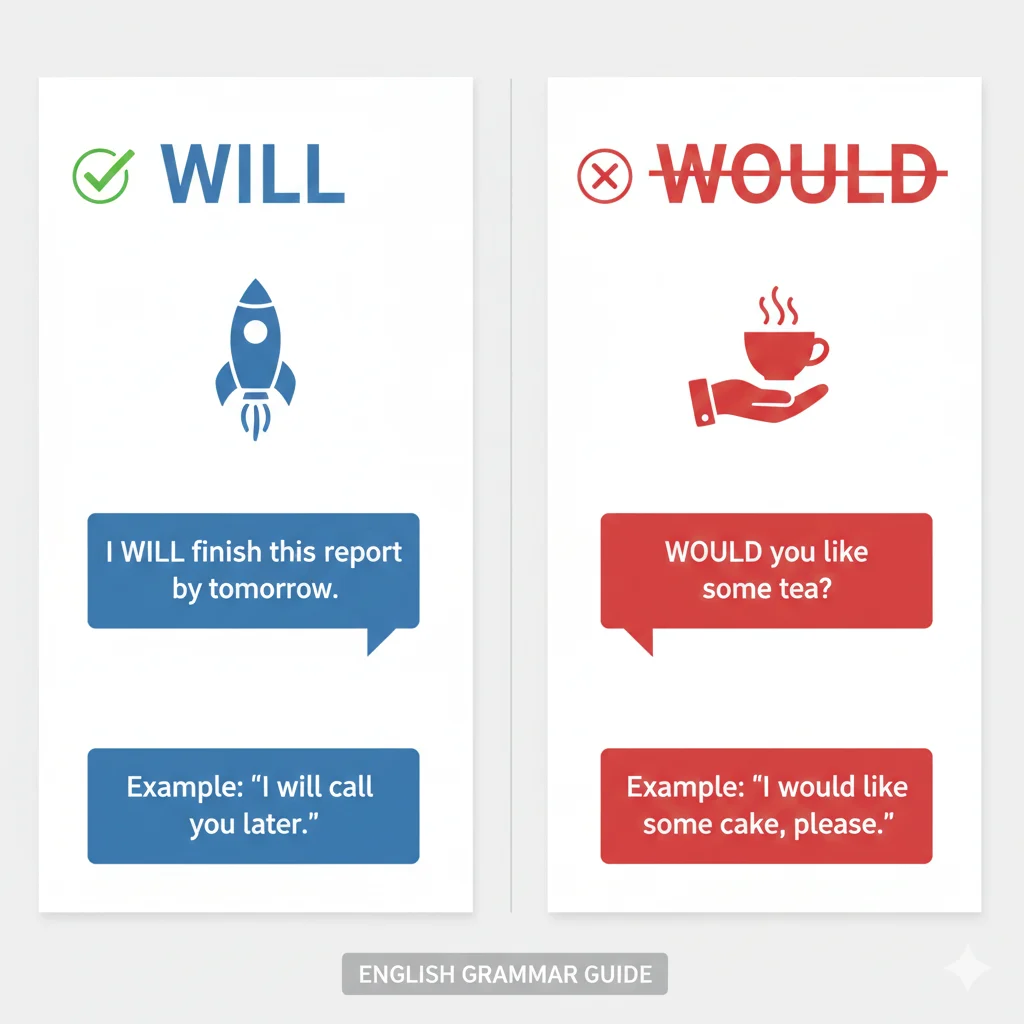
Many English learners and writers often get confused between “will” and “would.” Although both are auxiliary verbs, they are used in different contexts. “Will” expresses future certainty, promises, or intentions, while “would” is used for hypothetical situations, polite requests, or conditional statements. Using the wrong word can change the meaning of a sentence and confuse readers.
For example, saying “I will go to the market tomorrow” shows a definite plan, whereas “I would go to the market if it stopped raining” expresses a conditional or hypothetical situation. Understanding this difference ensures your sentences are clear, accurate, and professional.
Mastering when to use will and would improves communication, avoids misunderstandings, and makes your writing more polished and confident. Correct usage keeps readers engaged and ensures your content looks credible and easy to understand.
What Does Each Word Mean?
Before learning the difference, we must understand what each word means by itself.
What Does Will Mean?
Will is a helping verb (also called a modal verb). It is mainly used to talk about:
- The future
- Decisions made at the moment of speaking
- Promises
- Strong certainty or confidence
In simple words, will helps us talk about something that is going to happen or something we decide to do right now.
Easy Examples of Will
- I will call you tonight.
- She will help her brother with homework.
- It will rain tomorrow.
- We will meet after school.
- Don’t worry. Everything will be okay.
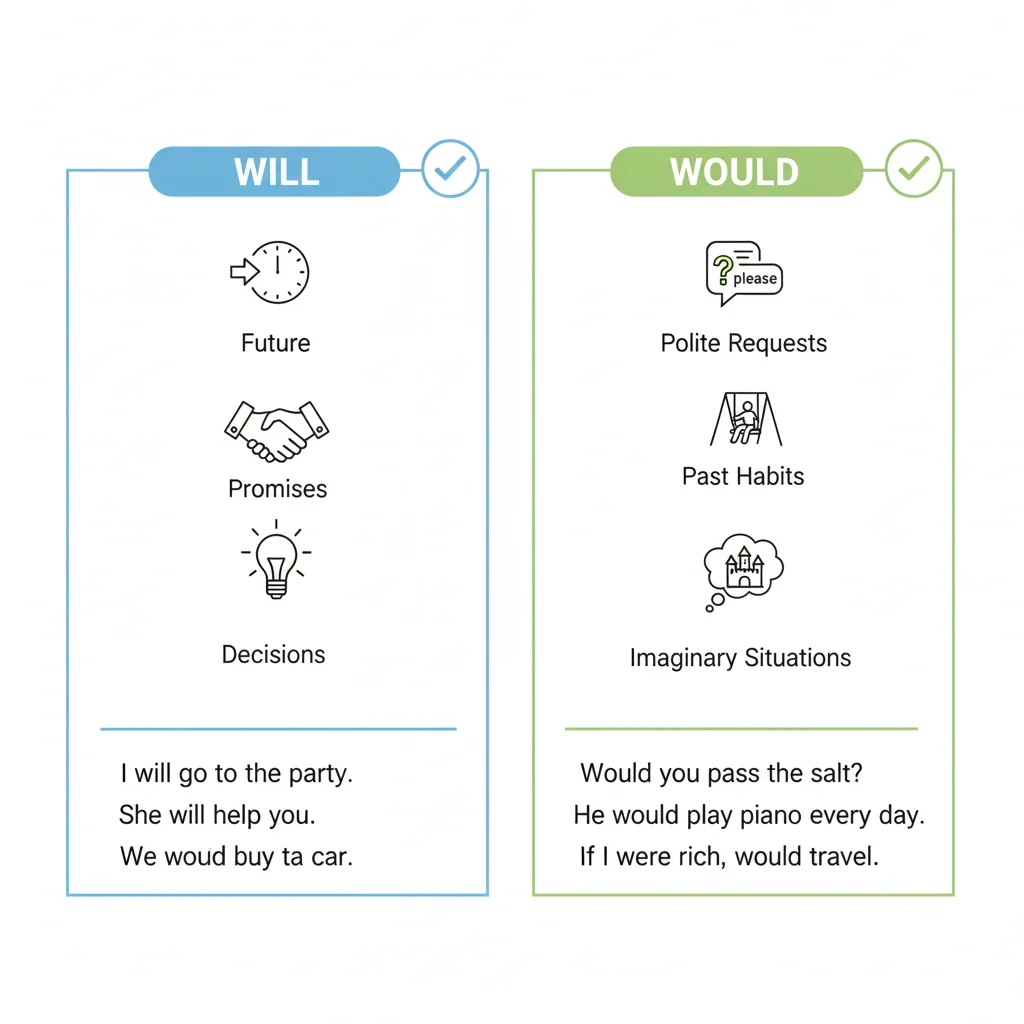
Each of these sentences talks about something that is expected to happen in the future or something the speaker strongly believes.
Memory Tip:
Think of will as a word that looks forward. It points to the future.
What Does Would Mean?
Would is also a helping verb. It is often used to talk about:
- Polite requests
- Imaginary or unreal situations
- Past habits
- The past form of will in reported speech
In simple words, would helps us speak softly, politely, or about situations that are not real right now.
Easy Examples of Would
- I would like some water, please.
- If I had a bike, I would ride to school.
- When I was young, I would play outside every day.
- She said she would come later.
- I would help you if I had time.
These sentences show politeness, imagination, habits from the past, or indirect speech.
Memory Tip:
Think of would as a soft and polite version of will.
The Key Difference Between Will and Would
The main difference between will and would is about:
- Time
- Certainty
- Politeness
- Reality
Simple Explanation
- Will is used when something is real, sure, and expected to happen.
- Would is used when something is polite, imaginary, unsure, conditional, or in the past.
Comparison Table
| Feature | Will | Would |
|---|---|---|
| Time | Future | Past, imagined, or polite |
| Meaning | Real plans, decisions, promises | Polite requests, unreal situations, habits |
| Tone | Strong and direct | Soft and gentle |
| Example | I will help you. | I would help you if I could. |
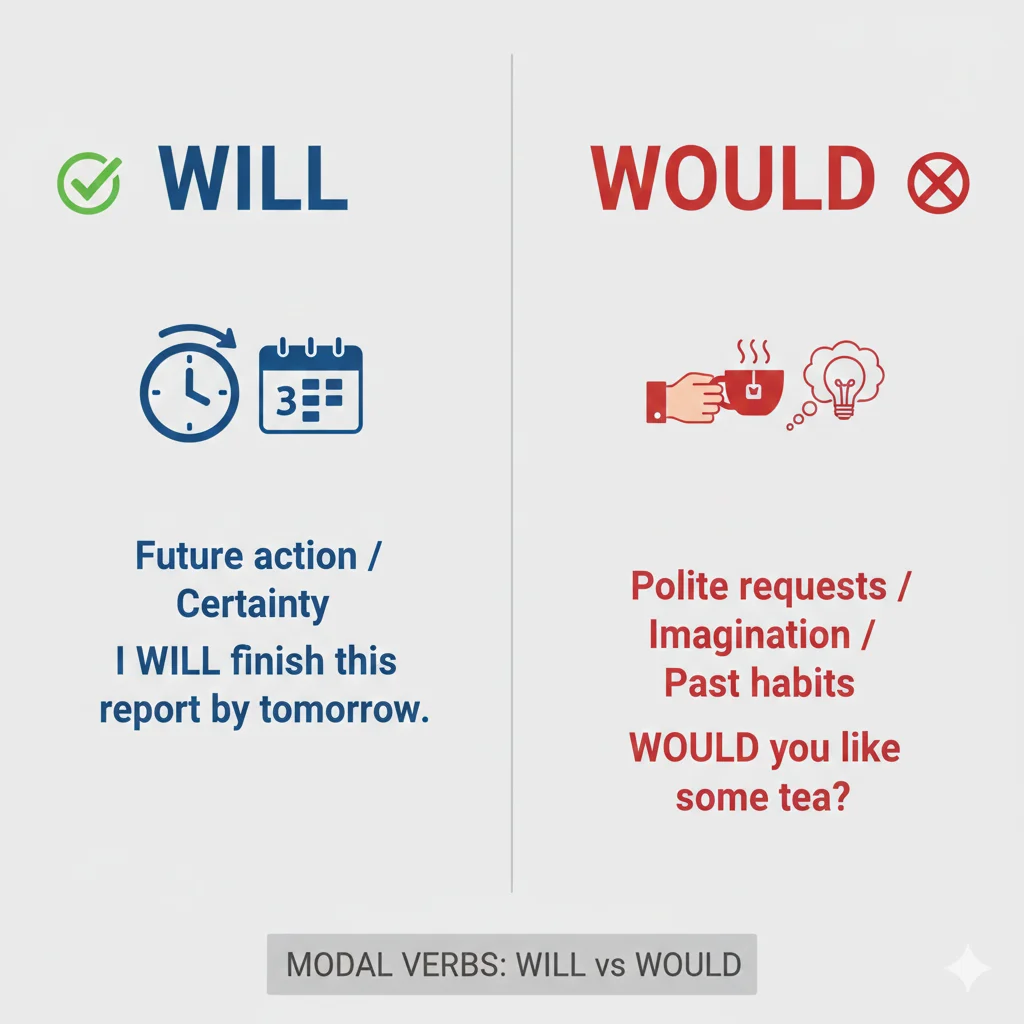
Quick Rule to Remember:
If it is real and sure, use will.
If it is polite, imaginary, or unsure, use would.
Common Mistakes and How to Avoid Them
Let’s look at mistakes people often make when using will and would, and learn how to fix them.
❌ Mistake 1
I would finish my homework tonight.
✅ Correct
I will finish my homework tonight.
Why?
This sentence talks about a real future plan, not an imaginary one. So will is correct.
❌ Mistake 2
Will you pass me the salt, please?
✅ Better
Would you pass me the salt, please?
Why?
Both are correct, but would sounds more polite and friendly.
❌ Mistake 3
When I was a child, I will play in the park.
✅ Correct
When I was a child, I would play in the park.
Why?
This sentence talks about a habit in the past, so would is needed.
❌ Mistake 4
If I were rich, I will buy a big house.
✅ Correct
If I were rich, I would buy a big house.
Why?
This is an imaginary situation, not real. So would is correct.
❌ Mistake 5
She said she will help me later.
✅ Correct
She said she would help me later.
Why?
This is reported speech about the past, so would is used.
When to Use Will
Now let’s look closely at the situations where will is the correct word.
1. To Talk About the Future
Use will when something is going to happen.
- I will visit my aunt tomorrow.
- They will start school next week.
- The train will arrive at 6 p.m.
- She will call you after lunch.
These sentences talk about real future actions.
2. To Make Decisions at the Moment of Speaking
Use will when you decide something right now.
- My phone is dead. I will charge it.
- I’m thirsty. I will drink some water.
- This bag is heavy. I will help you carry it.
- The room is messy. I will clean it.
These decisions were not planned earlier. They were made at the moment.
3. To Make Promises
Use will when you promise someone something.
- I will help you with your homework.
- We will always support you.
- I will never forget your kindness.
- She will call you back soon.
Promises often use will because they show strong intention.
4. To Show Strong Belief or Certainty
Use will when you feel sure about something.
- Don’t worry. Everything will be okay.
- He will understand your problem.
- She will win the competition.
- This medicine will help you feel better.
Here, the speaker feels confident.
5. To Offer Help or Services
Use will when offering to help someone.
- I will carry your bag.
- We will fix your computer.
- I will explain the lesson again.
- She will cook dinner tonight.
6. To Give Warnings or Strong Statements
- If you touch the fire, you will get burned.
- He will regret that decision.
- This road will take you to the city.
Easy Real-Life Examples of Will
- I will finish my work after dinner.
- She will call her friend later.
- We will win the match.
- I will help you find your book.
- Tomorrow will be a good day.
- The teacher will check our homework.
- My brother will come home soon.
- We will watch a movie tonight.
- I will tell you the truth.
- Everything will be fine.
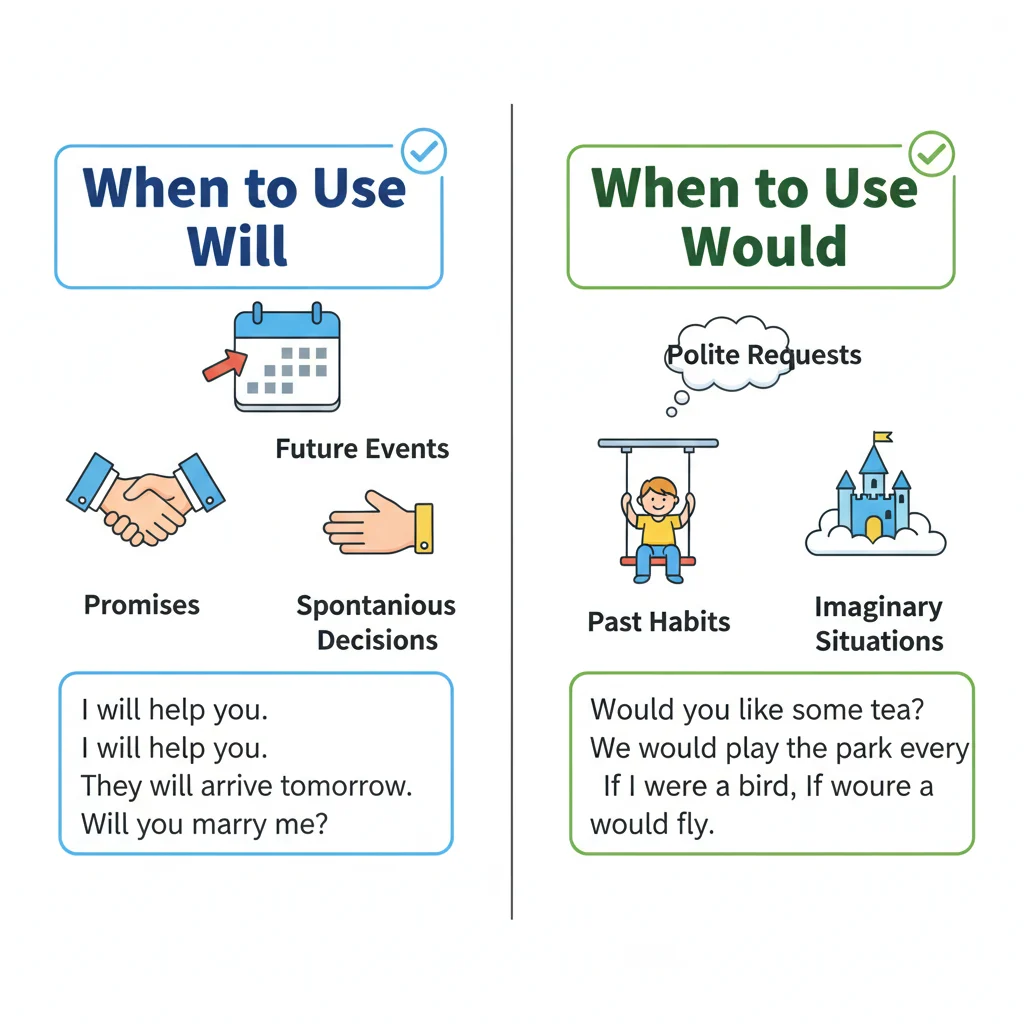
When to Use Would
Now let’s learn when would is the right choice.
1. To Make Polite Requests
Use would when asking for something politely.
- Would you open the window, please?
- Would you help me with this problem?
- Would you like some tea?
- Would you mind waiting for a moment?
These sound softer and kinder than using will.
2. To Talk About Imaginary or Unreal Situations
Use would when something is not real now or not likely to happen.
- If I were rich, I would travel the world.
- If she had wings, she would fly.
- I would buy a car if I had money.
- If it were sunny, we would go outside.
These sentences talk about dreams or situations that are not real right now.
3. To Talk About Past Habits
Use would to describe things that happened often in the past.
- When I was young, I would play outside every day.
- Every evening, Grandpa would tell us stories.
- On weekends, we would visit our cousins.
- She would walk to school when she was a child.
This use of would is similar to saying “used to.”
4. In Conditional Sentences
Use would when something depends on something else.
- I would help you if I had time.
- She would go if her parents allowed her.
- We would start earlier if everyone arrived on time.
- He would succeed if he worked harder.
These sentences show conditions.
5. In Reported Speech (Past Form of Will)
Use would when reporting what someone said in the past.
- She said she would come later.
- He told me he would call me.
- They promised they would help.
- The teacher said we would have a test.
6. To Express Soft Opinions or Wishes
- I would prefer juice to soda.
- I would love to visit Japan.
- I would rather stay at home.
- She would like to learn French.
These sentences sound gentle and polite.
Easy Real-Life Examples of Would
- Would you pass me the salt, please?
- I would help you if I could.
- When we were children, we would play in the park.
- She said she would come soon.
- I would love to meet your family.
- If I had time, I would read more books.
- Grandpa would wake up early every day.
- Would you like some coffee?
- I would choose blue instead of red.
- If it rained, we would stay inside.
Will vs Would in Daily Life Situations
Let’s look at real-life situations where people use will and would.
At Home
- I will clean my room.
- Would you help me set the table?
- Mom said she would cook dinner.
- Dad will fix the light.
At School
- The teacher will explain the lesson.
- I would like help with math.
- If I studied harder, I would get better grades.
- The principal said there would be a holiday.
With Friends
- I will meet you at 5 p.m.
- Would you like to watch a movie?
- I would join you if I were free.
- She said she would call me later.
At Work
- I will send the email today.
- Would you please check this file?
- The manager said he would review the report.
- I would suggest a different plan.
Quick Memory Tricks
Here are easy ways to remember the difference.
Trick 1: Real vs Unreal
- Real future → Will
- Unreal or imaginary → Would
Trick 2: Strong vs Soft
- Strong, direct → Will
- Soft, polite → Would
Trick 3: Now vs Then
- Now or future → Will
- Past, imagined, or polite → Would
Will and Would in Questions
Using Will in Questions
Use will when asking about plans or future actions.
- Will you come tomorrow?
- Will she finish her work?
- Will they join us?
These questions sound direct and normal.
Using Would in Questions
Use would when you want to sound polite or gentle.
- Would you help me, please?
- Would she like some water?
- Would they mind waiting?
These questions sound kinder and more respectful.
Will and Would in Negative Sentences
Negative with Will
Use will not or won’t.
- I will not forget your kindness.
- She won’t come today.
- We will not give up.
Negative with Would
Use would not or wouldn’t.
- I would not say that.
- He wouldn’t listen to advice.
- She would not agree.
Will and Would in Short Answers
- Will you help me?
→ Yes, I will. / No, I won’t. - Would you help me?
→ Yes, I would. / No, I wouldn’t.
Will vs Would in Stories and Writing
Using Will in Stories
Use will when talking about the future from the present moment.
- One day, he will become a doctor.
- This decision will change his life.
Using Would in Stories
Use would when describing past habits or repeated actions.
- Every evening, she would sit by the window.
- As a child, he would dream of flying.
Common Confusing Sentences Explained
Let’s look at sentences that confuse learners and explain them clearly.
Sentence 1:
I will help you.
This means:
I promise or I am sure I will help you.
Sentence 2:
I would help you.
This usually means:
I want to help, but maybe I cannot right now.
Sentence 3:
If I had time, I would help you.
This clearly shows:
I do not have time now.
Sentence 4:
She said she would call.
This means:
She said in the past that she planned to call.
Sentence 5:
Will you help me?
This sounds:
Normal and direct.
Sentence 6:
Would you help me?
This sounds:
More polite and gentle.
Will and Would with “Like”
- I will like it. ❌ (Usually incorrect)
- I would like it. ❌ (Also not natural)
Correct usage:
- I will like the movie. ✅ (Future liking)
- I would like some tea. ✅ (Polite request)
Will and Would with “Rather”
- I would rather stay home. ✅
- I will rather stay home. ❌
Will and Would with “Have”
- I will have dinner at 7 p.m. ✅
- I would have helped if I had known. ✅
Quick Recap: Will vs Would
- Will
- Used for real future actions
- Shows strong decisions and promises
- Sounds direct and confident
- Used for offers and certainty
- Would
- Used for polite requests
- Shows imaginary or unreal situations
- Used for past habits
- Sounds soft and gentle
Fast Rule:
Real future → Will
Polite, imaginary, or past → Would
Mini Quiz: Test Yourself
Fill in the blanks with will or would.
- I ______ call you later.
- ______ you like some water?
- If I had a car, I ______ drive to school.
- When we were children, we ______ play outside.
- Do not worry — everything ______ be okay.
- She said she ______ come tomorrow.
- ______ you help me with this bag?
- If it rained, we ______ stay inside.
- My brother ______ visit us next week.
- I ______ prefer tea to coffee.
Answers
- will
- would
- would
- would
- will
- would
- would
- would
- will
- would
Frequently Asked Questions (FAQs)
1. What is the main difference between will and would?
Will is used for real future actions, promises, and strong decisions.
Would is used for polite requests, imaginary situations, and past habits.
2. Can I use will instead of would in questions?
Yes, but would sounds more polite.
- Will you help me? → Normal
- Would you help me? → Politer
3. Is would always the past form of will?
No. Would can also show politeness, imagination, conditions, and habits.
4. Which word should I use in exams?
Use will for clear future facts and predictions.
Use would for conditional sentences and reported speech.
5. Can both words be correct in one situation?
Sometimes, yes — but the meaning changes.
- I will help you. → Strong promise
- I would help you. → Polite or conditional
Conclusion
Now you fully understand the difference between will and would. Will is used for real future actions, strong decisions, promises, and certainty. Would is used for polite requests, imaginary situations, past habits, and conditional sentences.
With regular practice, these words will become natural and easy for you. Try using them in daily conversations, school writing, messages, and exams. Every small step improves your English skills.
Keep learning, keep practicing, and enjoy growing stronger in English every day.

Wilkie Collins was a Victorian English novelist and playwright, pioneer of detective fiction and sensation novels, blending mystery, suspense, and social critique.