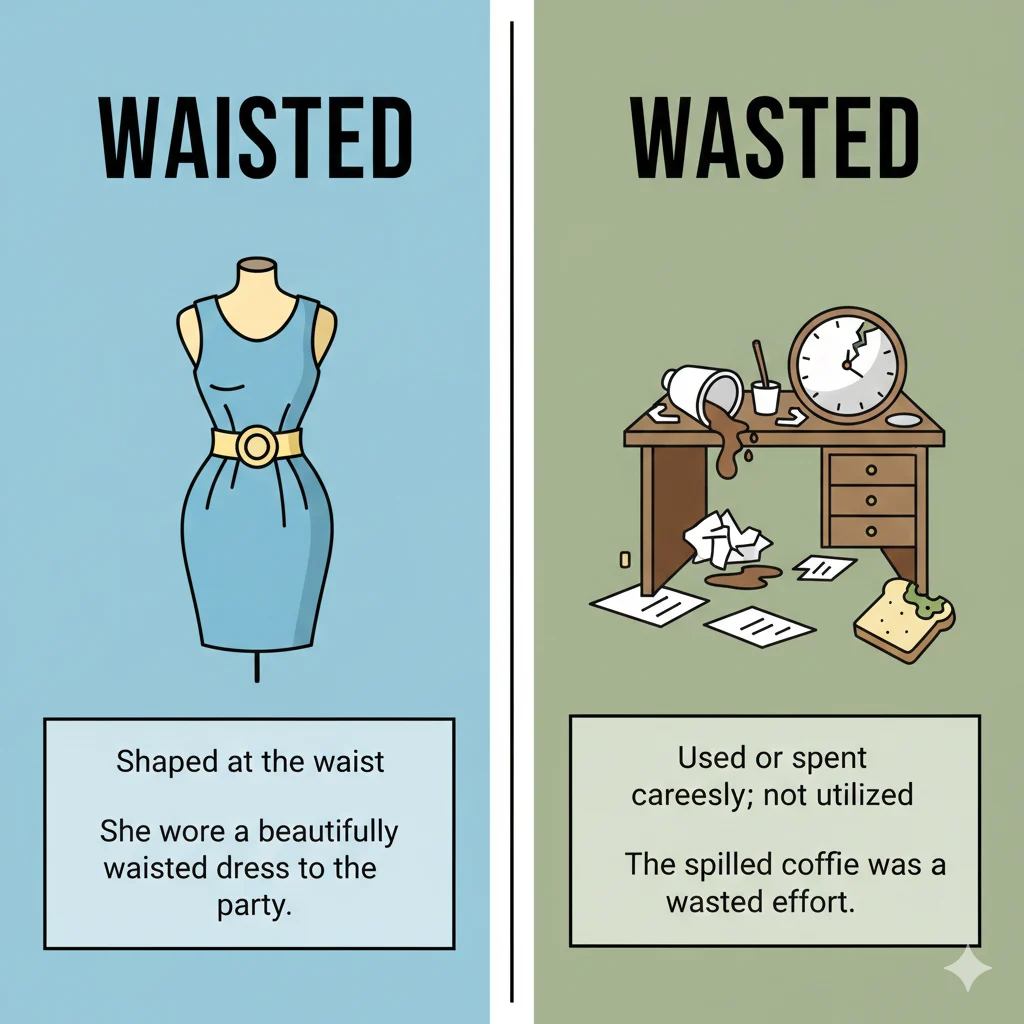
Many people learning English often get confused about the words waisted or wasted. They look very similar and sound almost the same when spoken. Because of this, it is easy to make spelling mistakes or use the wrong word in a sentence. But here’s the truth: even though only one letter is different, their meanings are completely different, and using the wrong one can change the meaning of your sentence.
For example:
- “I waisted my time.” ❌
- “I wasted my time.” ✅
Only one letter changes, but the meaning is completely different.
In this detailed guide, you will learn everything about waisted and wasted, including:
- The meaning of both words
- Correct usage with simple explanations
- Key differences with a comparison table
- Common mistakes and how to avoid them
- Real-life examples from school, work, and home
- Memory tricks to remember which word to use
- Advanced tips for formal writing
- A mini quiz to practice
By the end of this article, even beginners will confidently know when to use waisted and wasted.
Let’s start with the meaning of each word.
What Does “Waisted” Mean?
Simple Meaning
The word waisted means:
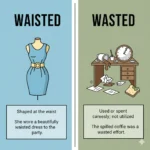
Shaped at the waist or having a waist.
It comes from the noun waist, which is the middle part of the body between the chest and hips.
Part of Speech
Waisted is an adjective.
Adjectives describe nouns, and in this case, it describes clothing or garments.
When to Use Waisted
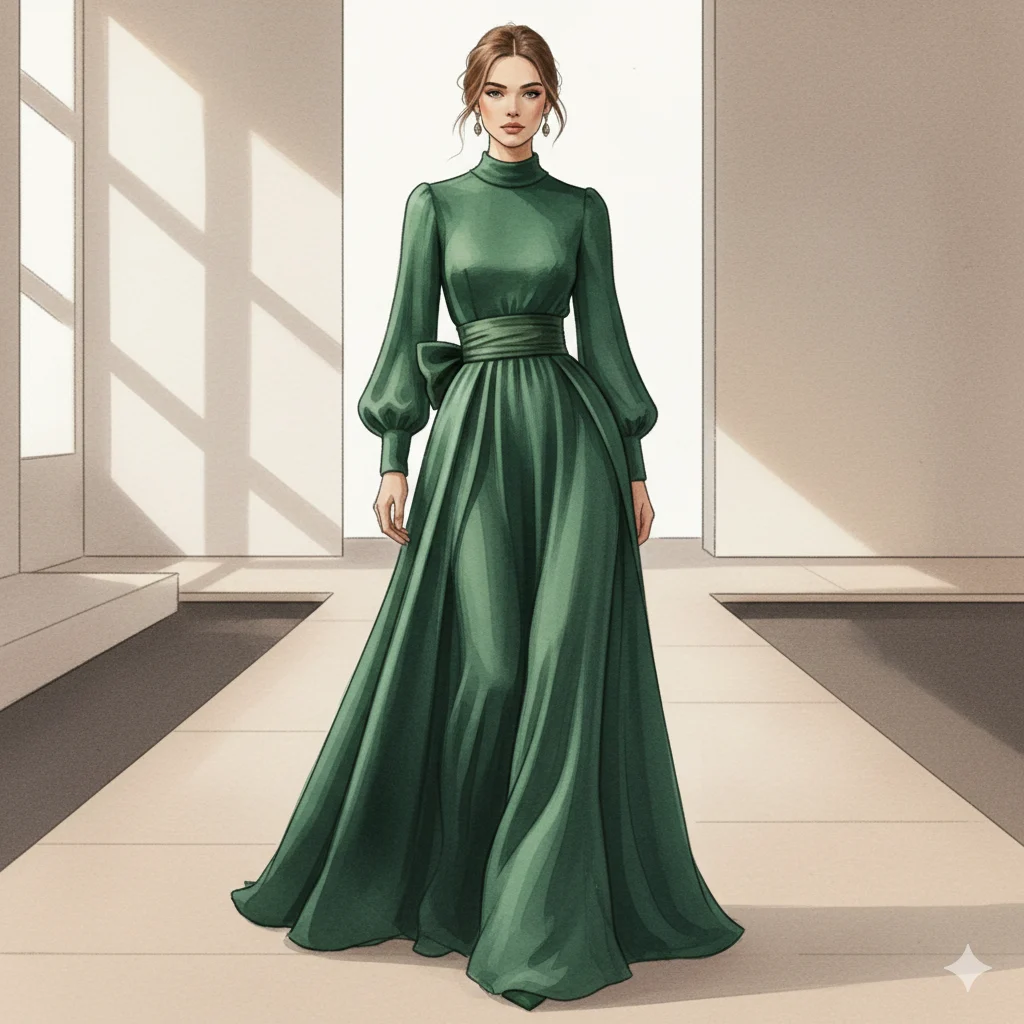
We use waisted mainly in fashion or clothing descriptions. It tells us that a dress, coat, or jacket is shaped around the waist.
This word is rare in everyday conversation but very common in fashion writing, tailoring, and style blogs.
Examples of Waisted
- She wore a beautifully waisted dress to the party.
- The coat is neatly waisted at the back.
- The designer created a slim waisted jacket.
- Her blouse has a softly waisted shape.
- The uniform is carefully waisted for a perfect fit.
Easy Memory Trick
Look at the word: W A I S T E D.
You can clearly see the word “waist” inside it.
If the sentence talks about the body or clothing shape → the correct word is waisted.
Think:
Waist → Body
Waisted → Clothing Shape
What Does “Wasted” Mean?
Simple Meaning
The word wasted means:
Used badly, lost, destroyed, or not used properly.
It comes from the verb waste.
Part of Speech
Wasted can be:
- The past tense of the verb waste
- An adjective

When to Use Wasted
We use wasted when something is not used wisely or is lost.
This word is very common in everyday English. You can use it with:
- Time
- Money
- Food
- Effort
- Opportunities
- Talent
- Energy
Examples of Wasted
- I wasted my time watching television.
- She wasted her money on unnecessary items.
- Do not let food get wasted.
- His talent was wasted in that job.
- That was a wasted opportunity.
- He got wasted at the party. (Informal: very drunk)
Easy Memory Trick
You often hear:
“Do not waste your time.”
You never hear:
“Do not waist your time.”
This makes it easy to remember the difference.
Waste → Loss
Wasted → Lost or misused
Key Difference Between Waisted and Wasted
Here’s a simple comparison table to help you remember:
| Feature | Waisted | Wasted |
|---|---|---|
| Meaning | Shaped at the waist | Used badly, lost, or misused |
| Related To | Clothing and body shape | Time, money, effort, food |
| Part of Speech | Adjective | Verb / Adjective |
| Usage | Rare | Very common |
| Example | A waisted dress | I wasted my time |
Quick Rule:
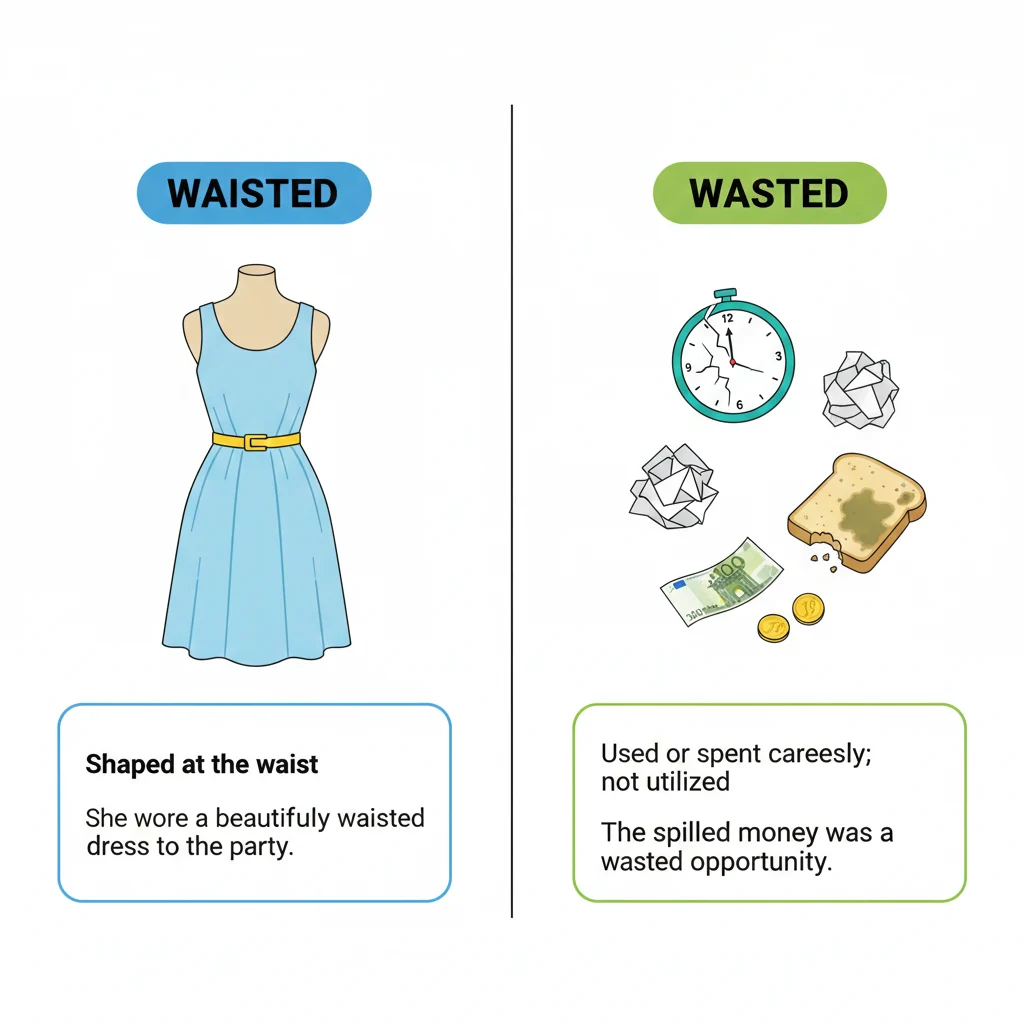
- Talking about clothing shape → waisted
- Talking about loss or misuse → wasted
One is about body shape, the other is about losing something.
Common Mistakes and How to Avoid Them
Many learners confuse these words because they look and sound very similar.
Mistake 1
Incorrect:
I waisted my time.
Correct:
I wasted my time.
Reason: Time cannot have a waist. It can only be lost.
Mistake 2
Incorrect:
She wore a wasted dress.
Correct:
She wore a waisted dress.
Reason: The dress is shaped at the waist, not lost or misused.
Mistake 3
Incorrect:
He does not want his talent to be waisted.
Correct:
He does not want his talent to be wasted.
Reason: Talent can be lost or misused, not shaped at the waist.
When to Use Waisted (Expanded)
Use waisted when describing clothing designed to fit at the waist.
Situations
- Fashion magazines
- Clothing advertisements
- Tailoring descriptions
- Writing about dress styles
More Examples
- The gown is elegantly waisted to highlight the figure.
- She prefers waisted jackets for winter.
- The coat is sharply waisted for a modern look.
- The school uniform is neatly waisted.
- The designer introduced a classic waisted style this season.
When to Use Wasted (Expanded)
Use wasted when something is lost, misused, or destroyed.
Situations
- Time
- Money
- Food
- Energy
- Effort
- Opportunities
More Examples
- I wasted three hours scrolling on my phone.
- He wasted his savings on unnecessary items.
- Do not let water get wasted.
- Her skills were wasted in that job.
- It would be wasted effort to argue.
- They wasted a great opportunity.
- I feel like I wasted my weekend doing nothing.
Real-Life Examples
At School
A teacher may say:
“Do not let your hard work be wasted.”
You would never say:
“Do not let your hard work be waisted.”
At Home
A parent may say:
“You wasted food. That is not good.”
Food can be lost, spoiled, or thrown away, but it cannot have a waist.
In Fashion
A designer may say:
“This dress is beautifully waisted.”
It makes sense because it describes the clothing’s shape.
At Work
A manager may say:
“Your time is being wasted on unnecessary tasks.”
Time cannot be shaped, so only wasted works here.
Advanced Tips for Learners
Word Origin
- Waisted comes from waist, referring to the body.
- Wasted comes from Old English “wæstan,” meaning to destroy, ruin, or throw away.
In Formal Writing
Spelling mistakes like “waisted” instead of “wasted” can cost marks in essays or exams. Always double-check.
Informal Usage
In casual conversation, “wasted” is often used for someone who is very drunk:
“He got wasted at the party.”
Quick Recap: Waisted vs Wasted
- Waisted: Clothing shaped at the waist, rare word, fashion context.
- Wasted: Lost, misused, very common, used for time, money, food, effort.
Simple way to remember:
Waist → Body → Waisted
Waste → Loss → Wasted
Mini Quiz
Fill in the blanks with waisted or wasted:
- She wore a ______ dress to the wedding.
- I ______ my entire afternoon scrolling online.
- Do not let food get ______.
- The uniform is neatly ______.
- He felt his opportunity was ______.
- She ______ her money on unnecessary clothes.
- The coat is beautifully ______.
- They ______ a lot of time arguing.
- The gown is perfectly ______ for her figure.
- That was a ______ chance to impress the teacher.
Answers
- waisted
- wasted
- wasted
- waisted
- wasted
- wasted
- waisted
- wasted
- waisted
- wasted
Conclusion
Now you clearly understand the difference between waisted and wasted.
- Waisted → describes clothing shaped at the waist.
- Wasted → describes something lost, misused, or destroyed.
Even though these words look similar, their meanings are completely different. With practice, you will never confuse them again.
Remember:
Waist = Body
Waste = Loss
Keep practicing and using these words in real-life situations. Your English will improve every day!

Dorothy Whipple was an English novelist and short story writer, famed for emotional realism, domestic themes, and sharp insight into women’s lives. worldwide UK