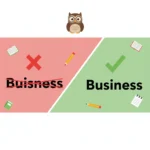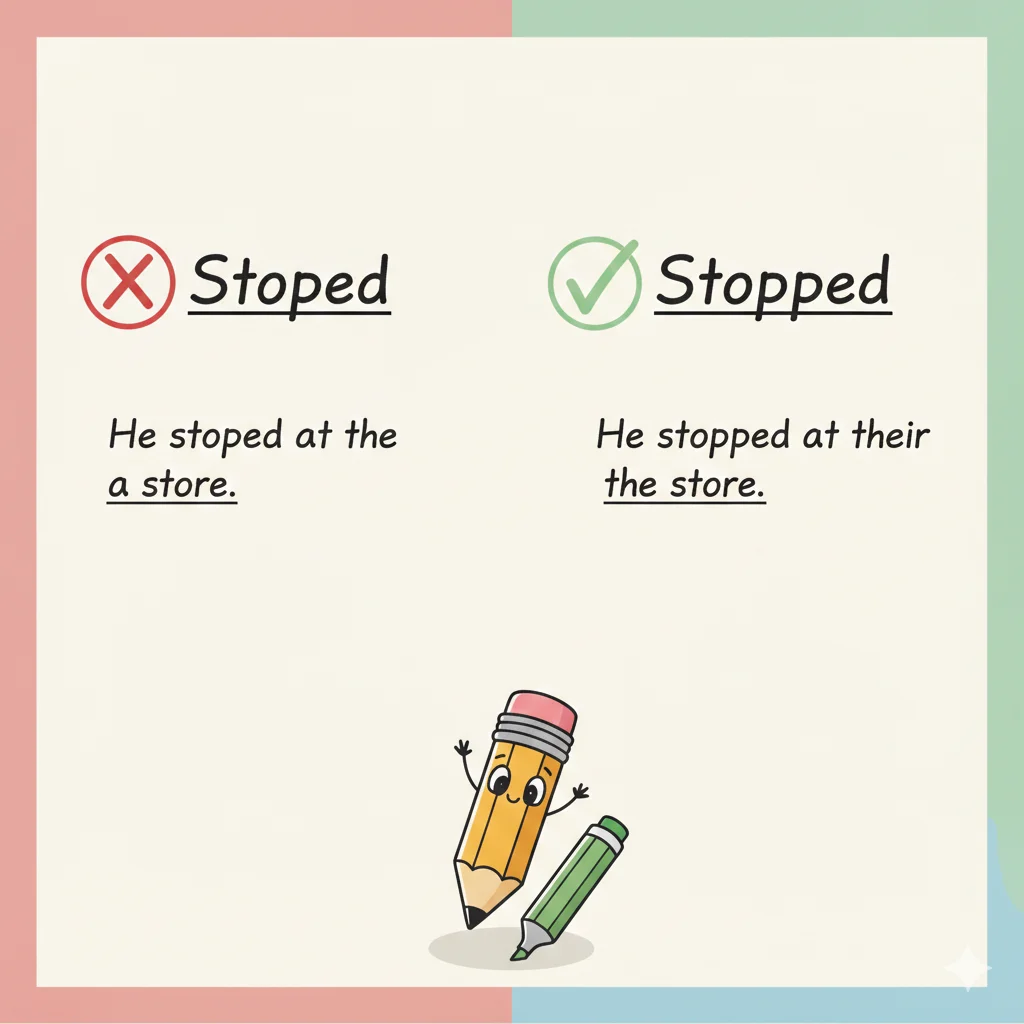
Have you ever written a sentence and paused to wonder, “Is it stoped or stopped?” You are not alone. This is one of the most common spelling and grammar mistakes in English. Many learners, students, and even adults mix up these two words because they sound the same when spoken. But in writing, only one is correct.
In this easy guide, you will clearly learn the difference between stoped and stopped, what each word means, and how to use the correct one every time. We will use simple English, short sentences, and real-life examples. You do not need to know hard grammar rules to understand this lesson. By the end, even a 4th-grade student will feel confident using the right word.
Let’s make English simple, clear, and stress-free 😊
What Does Each Word Mean?
Before we compare them, let’s look at what each word really means.
What Does Stopped Mean?
Stopped is the correct word.
It is the past tense and past participle of the verb stop.
Stop means:
- To not move anymore
- To end something
- To pause doing something
When we talk about the past, we say stopped.
Part of speech: Verb (action word)

Easy Examples of Stopped:
- The bus stopped at the red light.
- She stopped talking when the teacher entered.
- It stopped raining in the afternoon.
👉 Think of stopped as saying: “It already ended.”
What Does Stoped Mean?
Stoped is not a correct spelling in modern English.
It is a common spelling mistake.
You should not use “stoped” in normal writing, schoolwork, emails, or exams.
Some people write stoped because they think:
- “Stop” + “ed” = stoped
But English has a spelling rule that changes this word.
👉 The correct form is always stopped, not stoped.
The Key Difference Between Stoped and Stopped
The difference is very simple:
| Word | Correct? | Meaning | Usage | Example |
|---|---|---|---|---|
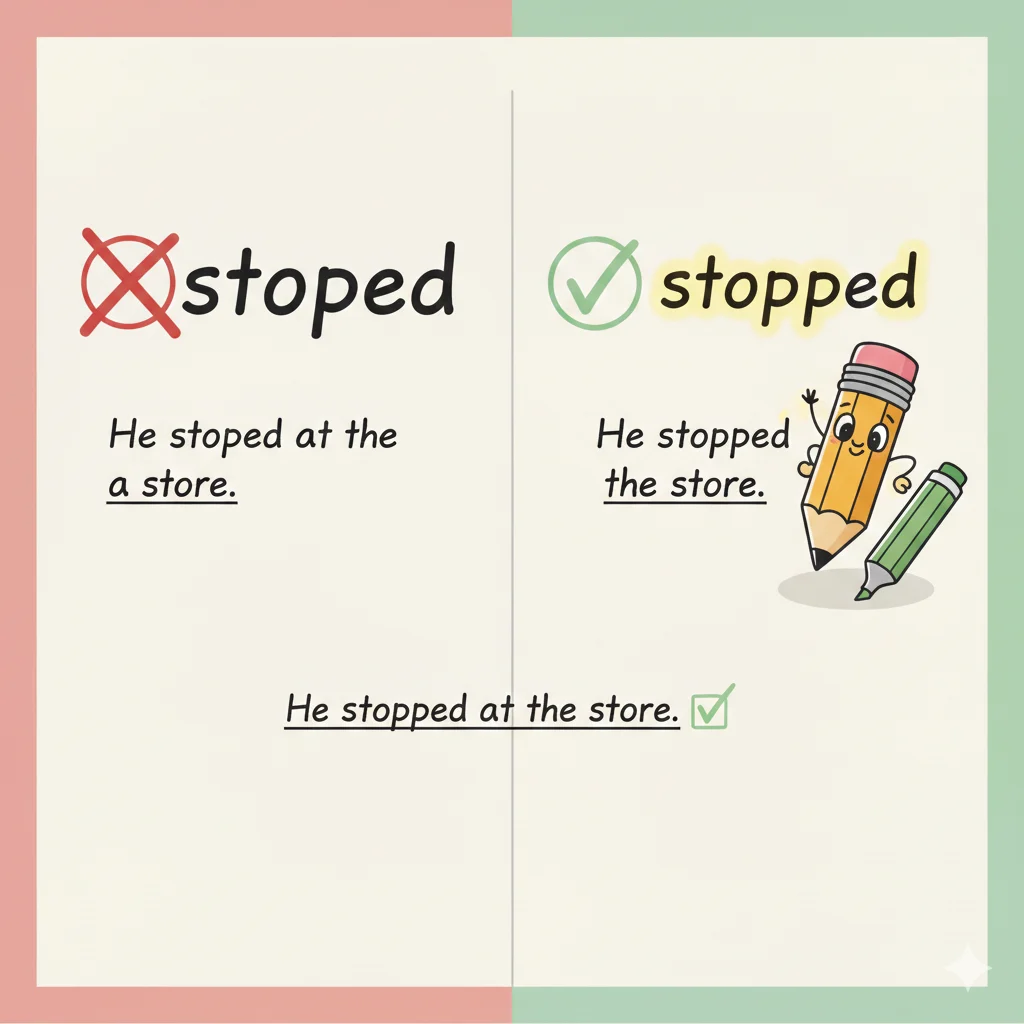
| Stoped | ❌ No | Not a real word | Wrong spelling | ❌ The car stoped |
| Stopped | ✅ Yes | Past of stop | Correct English | ✅ The car stopped |

Quick Tip to Remember
👉 Double the “P” before adding -ed
If a word ends with one vowel + one consonant, we double the consonant.
- stop → stopped
- hop → hopped
- run → ran (special case)
If you see stoped, remember: “Oops! Missing a P!”
Why Do People Confuse Stoped and Stopped?
This mistake happens for three main reasons:
- They sound the same
When we speak, “stoped” and “stopped” sound alike. - English spelling rules are tricky
Not all words follow the same pattern. - Typing fast or autocorrect mistakes
Phones sometimes don’t fix it.
But once you learn the rule, this mistake becomes easy to avoid.
Common Mistakes and How to Avoid Them
Let’s look at some wrong sentences and fix them.
❌ Mistake 1:
The game stoped because of rain.
✅ Correct:
The game stopped because of rain.
Why it’s wrong:
“Stoped” is missing one P.
❌ Mistake 2:
He stoped eating junk food.
✅ Correct:
He stopped eating junk food.
Why it’s wrong:
Past tense of stop always uses stopped.
❌ Mistake 3:
The car has stoped working.
✅ Correct:
The car has stopped working.
Why it’s wrong:
Even with “has” or “have,” we still use stopped.
How to Avoid These Mistakes
✔ Always check if “stop” is in the past
✔ Remember: Double P rule
✔ Read the sentence slowly before submitting
When to Use Stopped
Use stopped whenever you talk about something that ended in the past.
Situations Where You Use Stopped:
- When something ended
- When someone paused
- When movement ended
- When an action finished
Simple Real-Life Examples:
- The teacher stopped the class early.
- We stopped playing after dinner.
- The dog stopped barking.
- She stopped watching TV.
- The rain stopped at night.
👉 If it already happened, use stopped.
When to Use Stoped
👉 Never.
There is no correct situation where stoped should be used in everyday English.
If you see this word:
- In homework ❌
- In an exam ❌
- In an email ❌
It is always a spelling error.
Simple Grammar Rule (Explained Like a Story)
Imagine the word stop is walking.
When it goes into the past, it gets tired.
So it sits down and brings a friend (P).
That’s why:
- stop → stopped
The extra P helps the word stay balanced 😊
Quick Recap: Stoped vs Stopped
- Stopped ✅
- Correct spelling
- Past tense of stop
- Used in real English
- Stoped ❌
- Wrong spelling
- Do not use it
👉 If you are unsure, always choose stopped.
Advanced Tips (Optional but Helpful)
A Short History Tip
In older English (hundreds of years ago), spelling was not fixed. Today, stopped is the standard and accepted form everywhere.
In Exams and Formal Writing
Using stoped can:
- Lower your marks
- Look careless
- Change how teachers judge your writing
Always double-check spelling in exams.
In Texting and Online Writing
Even in casual writing:
- “stopped” looks correct
- “stoped” looks uneducated
Good spelling builds confidence.
Mini Quiz: Test Yourself 🎯
Fill in the blanks with stopped.
- The bus ________ near my house.
- She ________ talking when mom called.
- It ________ raining after lunch.
- The boy ________ running because he was tired.
- The clock ________ working yesterday.
Answers:
- stopped
- stopped
- stopped
- stopped
- stopped
Great job if you got them right! 👏
FAQs: Stoped or Stopped
1. Is “stoped” ever correct?
No. Stoped is always wrong in modern English.
2. Why does “stop” become “stopped”?
Because of the double consonant rule in English spelling.
3. Is “stopped” past tense or present tense?
It is past tense and past participle.
4. Can I use “stopped” with has or have?
Yes.
Example: She has stopped talking.
5. How can I remember the correct spelling?
Remember: Stop + P + ed = stopped
Conclusion
Now you clearly know the difference between stoped and stopped. One is a common mistake, and the other is the correct English word. Remember that stopped is always right when talking about the past. By learning this small spelling rule, you can avoid errors in school, exams, and daily writing.
English gets easier when you understand simple rules like this. Keep practicing. Keep reading. And don’t worry about mistakes — every mistake is a step toward better English.
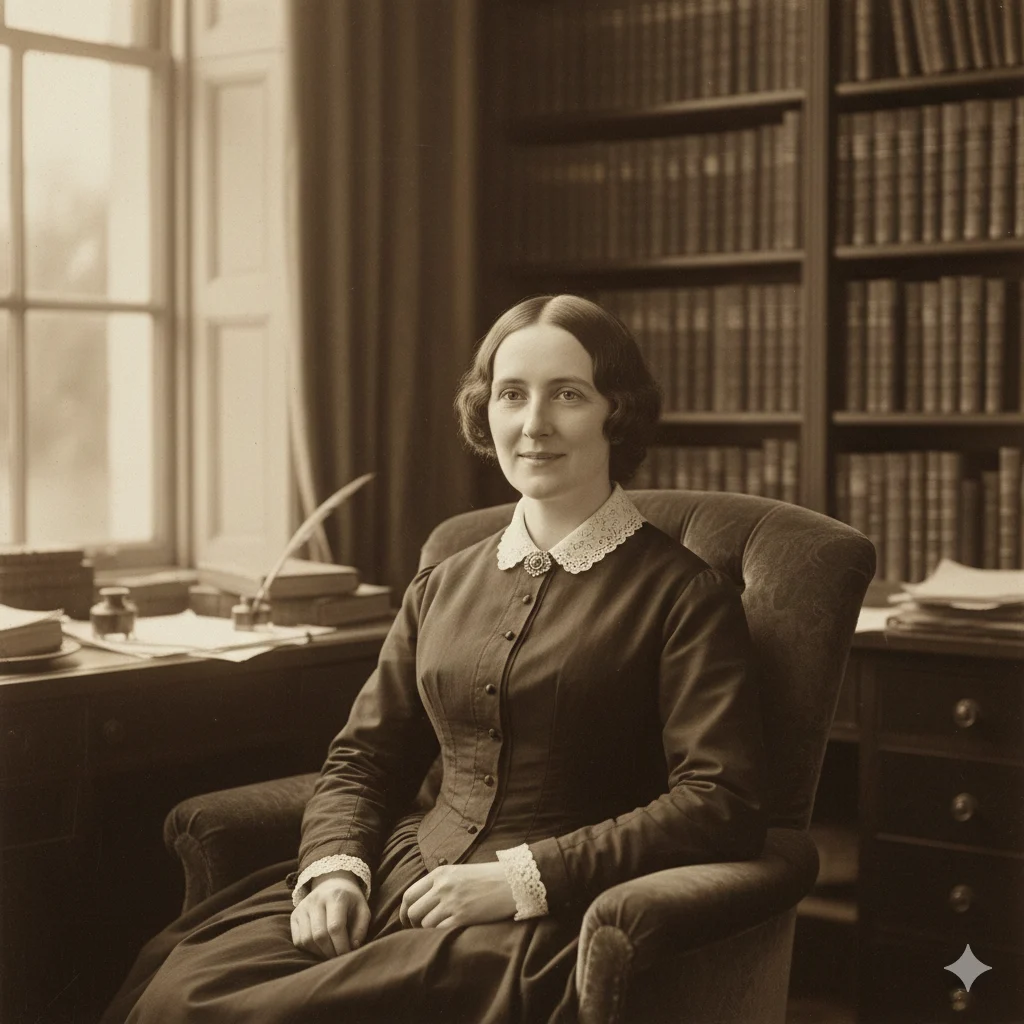
Elizabeth Gaskell was a Victorian English novelist and biographer, celebrated for social realism, strong female characters, and industrial age themes. era life.