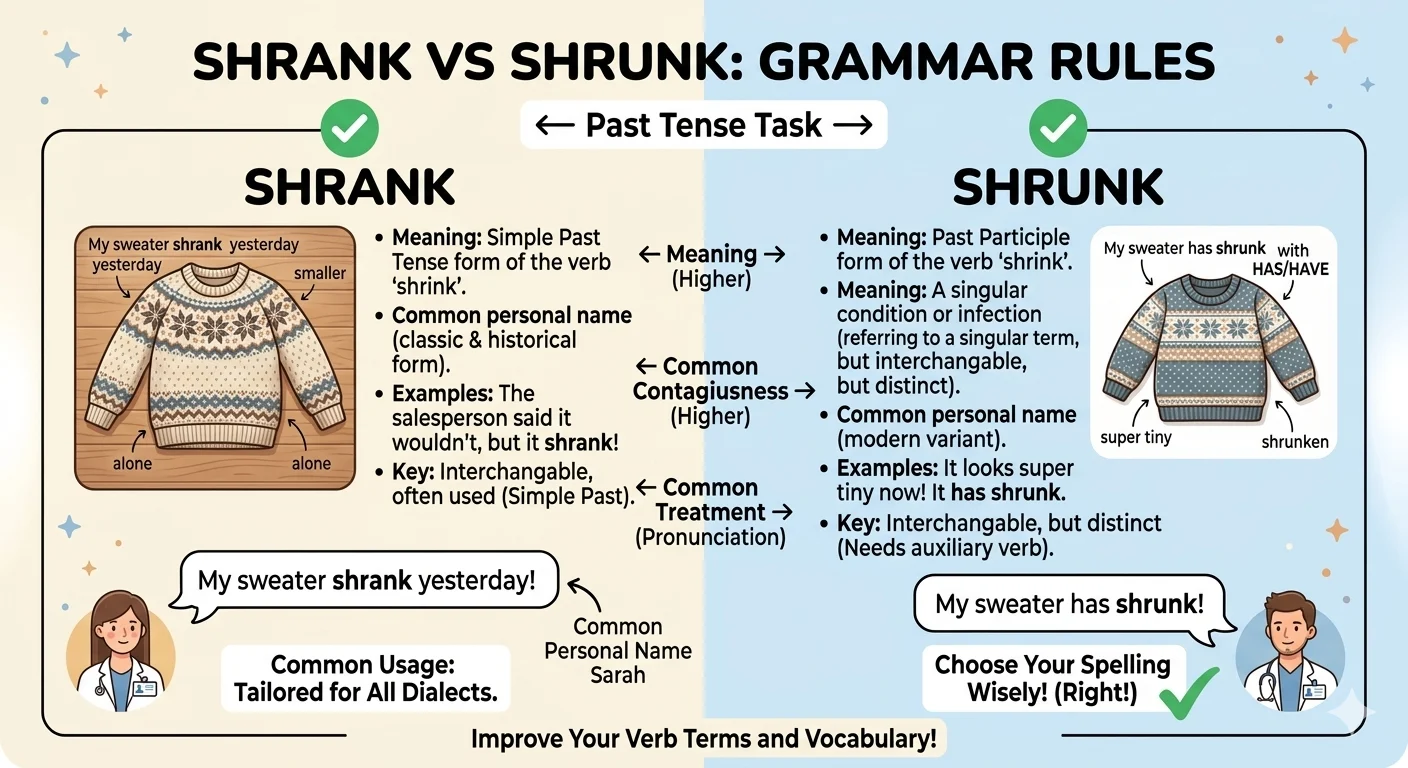
Many English learners get confused about “shrank” or “shrunk.” Both words come from the same verb “shrink,” and both relate to something becoming smaller. Because they look and sound similar, people often mix them up when writing or speaking.
You might see questions online like “Is shrunk a word?”, “What is the meaning of shrank?”, or “Has shrunk or has shrunken – which is correct?” These are common grammar doubts, even for native speakers.
The truth is that shrank and shrunk are both correct, but they are used in different grammar situations. Understanding the difference will help you write clearer sentences and avoid common mistakes.
In this simple guide, you will learn:
- The meaning of shrank and shrunk
- The difference between shrank or shrunk
- When and how to use each word correctly
- Easy examples from daily life
- Common grammar mistakes and how to avoid them
By the end, even a beginner will clearly understand how to use these words correctly.
What Does Each Word Mean?
Before learning the difference, let’s understand the basic meaning.
The base verb is shrink. It means to become smaller, shorter, or tighter.
For example, clothes can shrink after washing, or a balloon can shrink when air escapes.
Meaning of “Shrank”
Shrank is the past tense of the verb shrink.
It describes something that became smaller in the past.
Think of it as something that already happened.
Simple definition:
Shrank = became smaller in the past
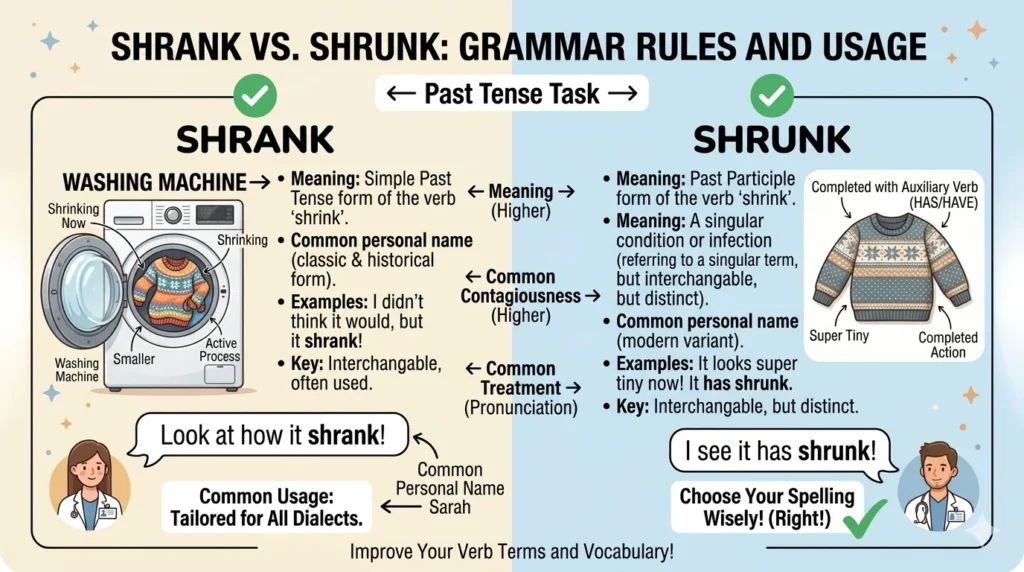
Examples:
- My sweater shrank after I washed it in hot water.
- The balloon shrank when the air slowly came out.
- His shirt shrank in the dryer.
In all these examples, the action already happened in the past.
Many learners ask: What is the meaning of shrank?
The answer is simple:
It means something became smaller or tighter before now.
Meaning of “Shrunk”
Shrunk is the past participle form of the verb shrink.
It is usually used with helping verbs like:
- has
- have
- had
Simple definition:
Shrunk = something that has become smaller
Examples:
- My jeans have shrunk after washing.
- The balloon has shrunk overnight.
- The ice cube has shrunk in the sun.
Many learners also ask:
What is meant by shrunk?
It means that something became smaller and the result is visible now.
Another question people ask is “Is shrunk a word?”
Yes, shrunk is a real and correct English word. It is the past participle of shrink.
The Key Difference Between Shrank and Shrunk
The main difference is grammar usage.
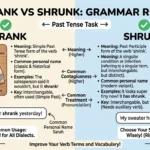
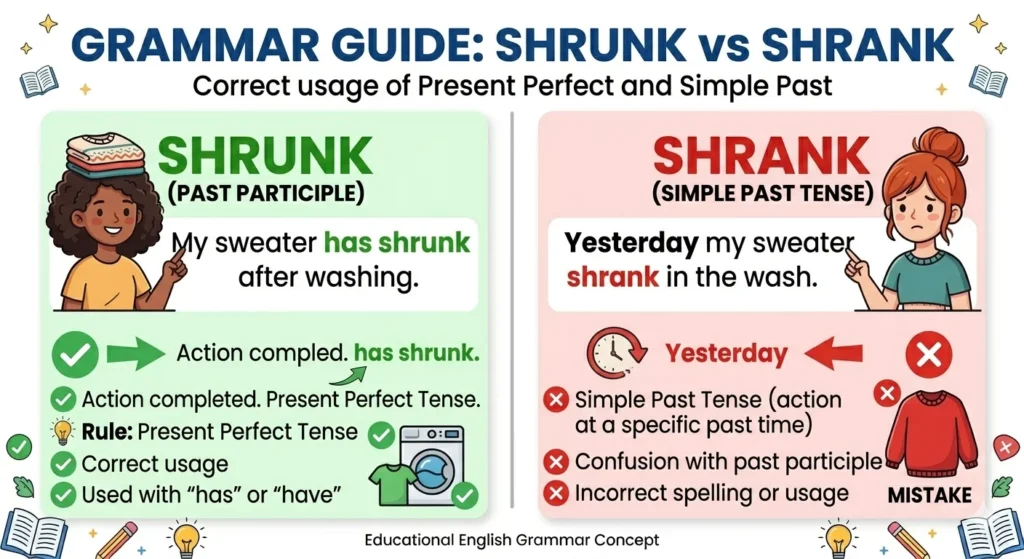
| Word | Grammar Form | Meaning | Example |
|---|---|---|---|
| Shrank | Past tense | Something became smaller in the past | My shirt shrank in the dryer. |
| Shrunk | Past participle | Used with has/have/had | My shirt has shrunk after washing. |
Quick Tip to Remember
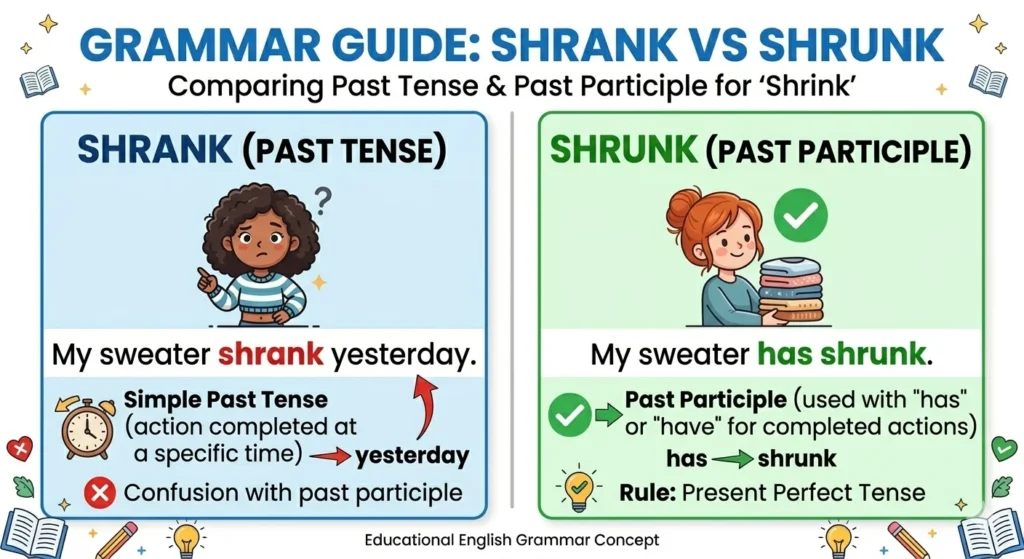
Think of it like this:
Yesterday → shrank
Has/Have → shrunk
Example:
- Yesterday my sweater shrank.
- My sweater has shrunk after washing.
This simple trick helps many learners remember the difference.
Understanding the Verb Forms of “Shrink”
The verb shrink has three main forms:
| Verb Form | Example |
|---|---|
| Base verb | shrink |
| Past tense | shrank |
| Past participle | shrunk |
This means the correct shrink past tense and past participle forms are:
- Past tense → shrank
- Past participle → shrunk
Examples:
- The shirt shrank in the wash.
- The shirt has shrunk after washing.
Common Mistakes and How to Avoid Them
Because these words are similar, many people make mistakes.
Let’s look at a few common errors.
Mistake 1
❌ My sweater has shrank.
Correct:
✅ My sweater has shrunk.
Explanation:
After has, we must use the past participle (shrunk).
Mistake 2
❌ My shirt shrunk yesterday.
Correct:
✅ My shirt shrank yesterday.
Explanation:
When talking about a past action with a time word like yesterday, use shrank.
Mistake 3
❌ The jeans have shran.
Correct:
✅ The jeans have shrunk.
Explanation:
Only shrunk works as the past participle.
When to Use “Shrank”
Use shrank when describing something that happened in the past without a helping verb.
Examples:
- My cotton shirt shrank after washing.
- The sweater shrank in the dryer.
- The balloon shrank when the air escaped.
- His jacket shrank because of hot water.
- The wool socks shrank overnight.
These examples show actions that happened earlier.
You will often see time words like:
- yesterday
- last night
- earlier
- last week
Example:
- My sweater shrank yesterday.
When to Use “Shrunk”
Use shrunk when the sentence includes a helping verb.
Examples:
- My sweater has shrunk after washing.
- The balloon has shrunk overnight.
- The ice cube has shrunk in the sun.
- The shirt had shrunk before I noticed.
- My jeans have shrunk in the dryer.
Memory Hack
Look for these helper words:
has / have / had
If you see them, the correct word is usually shrunk.
Example:
- The sweater has shrunk.
Shrunken Meaning and Usage
Sometimes you may also see the word shrunken.
This word works like an adjective.
It describes something that has already become smaller.
Example sentences:
- The apple looked shrunken after drying.
- He wore a shrunken sweater by mistake.
- The old balloon looked shrunken.
So the shrunken meaning is simply:
Something that has already shrunk.
Has Shrunk or Has Shrunken?
This is another common grammar question.
Both forms exist, but they are used differently.
Example:
- The sweater has shrunk.
- The sweater looks shrunken.
Explanation:
- Has shrunk → verb phrase
- Shrunken → adjective
Real-Life Example: “Honey, I Shrunk the Kids”
You may remember the movie “Honey, I Shrunk the Kids.”
Many learners ask:
Is “Honey I shrunk the kids” grammatically correct?
Yes, it is correct.
Why?
Because shrunk can also be used informally as a past tense in everyday speech. However, in formal grammar, many teachers prefer shrank as the past tense.
Example:
- Formal: I shrank the sweater.
- Informal: I shrunk the sweater.
Both are understood, but shrank is traditionally considered the standard past tense.
Quick Recap: Shrank vs Shrunk
Here is a simple summary.
Shrank
- Past tense of shrink
- Used for past actions
- Example: My sweater shrank.
Shrunk
- Past participle
- Used with has / have / had
- Example: My sweater has shrunk.
Shrunken
- Adjective
- Describes something smaller
- Example: A shrunken apple
Advanced Grammar Tip
English verbs sometimes have irregular forms.
Shrink is one of them.
Old grammar forms were:
- shrink
- shrank
- shrunk
- shrunken
Over time, everyday English started using shrunk more often.
That’s why people sometimes ask online questions like:
- Shrank or shrunk Reddit discussions
- Is shrunk a word
- Shrink past tense
Both forms are understood today, but traditional grammar still prefers:
shrank → past tense
shrunk → past participle
Mini Quiz: Test Your Knowledge
Fill in the blanks with shrank or shrunk.
- My sweater ______ after washing.
- The balloon has ______ overnight.
- The cotton shirt ______ in hot water.
- My jeans have ______ in the dryer.
- The ice cube ______ quickly in the sun.
- The sweater has ______ since last week.
Answers:
- shrank
- shrunk
- shrank
- shrunk
- shrank
- shrunk
FAQs
What is the meaning of shrank?
Shrank means became smaller in the past. It is the past tense of the verb shrink.
Example: My sweater shrank in the dryer.
What is meant by shrunk?
Shrunk means has become smaller. It is the past participle of the verb shrink.
Example: My sweater has shrunk after washing.
Is shrunk a word?
Yes, shrunk is a correct English word. It is commonly used as the past participle of shrink.
What is the past tense of shrink?
The traditional shrink past tense is shrank.
Example: The shirt shrank in hot water.
When should I use shrunken?
Use shrunken as an adjective to describe something that has already become smaller.
Example: The fruit looked shrunken after drying.
Conclusion
Understanding the difference between shrank or shrunk is easier than it seems. Both words come from the verb shrink, which means to become smaller.
The key rule is simple:
- Shrank is used for past actions.
- Shrunk is used with helping verbs like has, have, or had.
You may also see shrunken, which works as an adjective describing something that has already become smaller.
With a little practice, you will quickly learn to choose the right word in any sentence. Keep practicing with simple examples from daily life, and your English will continue to improve every day.

Wilkie Collins was a Victorian English novelist and playwright, pioneer of detective fiction and sensation novels, blending mystery, suspense, and social critique.