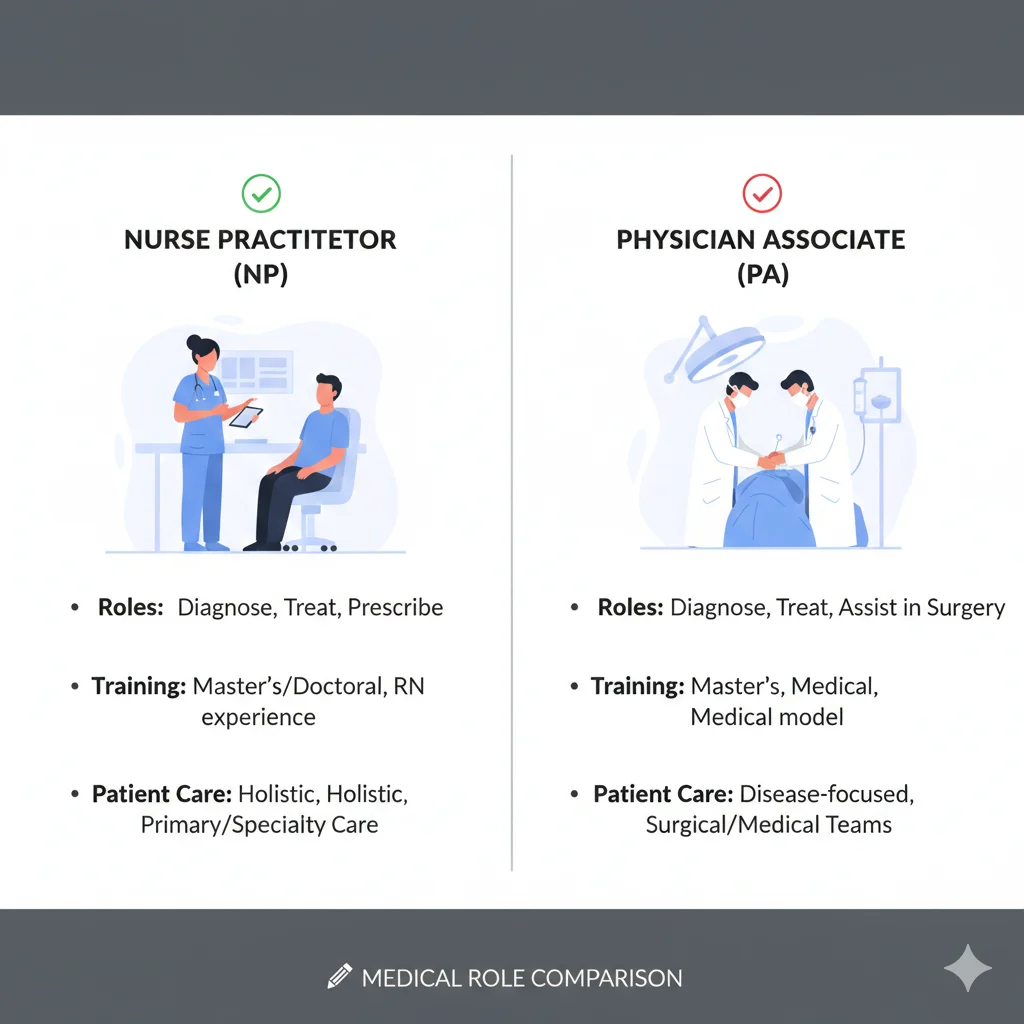
You may have seen the letters NP or PA on a doctor’s office door, hospital badge, or clinic website and wondered what they mean. Many people mix them up because both Nurse Practitioners and Physician Assistants help treat patients, prescribe medicine, and work closely with doctors. They both wear white coats. They both listen to patients. And they both help people feel better.
So what’s the real difference?
In this easy guide, you’ll learn what NP and PA mean, how they are different, and when each one is used. You’ll also see simple examples from daily life, school, and doctor visits. By the end, you’ll clearly understand NP vs PA — even if you’re learning about healthcare for the first time.
Let’s make this simple, clear, and stress-free. 😊
What Does Each Term Mean?
What Does NP Mean?
NP stands for Nurse Practitioner.
A Nurse Practitioner is a nurse who has extra education and training to care for patients at a higher level. NPs can:
- Check patients
- Diagnose illnesses
- Order tests
- Prescribe medicines
- Give health advice
They often focus on patient care, wellness, and long-term health.
Part of speech:
NP is a noun. It names a type of healthcare professional.

Easy Examples of NP
- The NP checked my sore throat and gave me medicine.
- I see an NP for my yearly health check-up.
- The nurse practitioner helped my grandma manage her diabetes.
Simple story:
Think of an NP as a super nurse. First, they become a nurse. Then, they go back to school to learn how to diagnose and treat patients like a doctor does — but with a strong nursing background.
What Does PA Mean?
PA stands for Physician Assistant.
A Physician Assistant is a medical professional trained to practice medicine with a doctor’s supervision. PAs can:
- Examine patients
- Diagnose problems
- Order tests
- Prescribe medicine
- Help in surgeries
They work closely with doctors in hospitals, clinics, and emergency rooms.
Part of speech:
PA is also a noun. It names a type of healthcare worker.
Easy Examples of PA
- The PA stitched my cut after I fell off my bike.
- A physician assistant saw me before the doctor came in.
- The PA explained my test results clearly.
Simple story:
Think of a PA as a doctor’s right-hand helper. They study medicine and work with doctors to treat patients and solve health problems.
The Key Difference Between NP and PA
Both NPs and PAs help treat patients, but their training, background, and way of working are different.
Here’s a clear and simple comparison table:
| Feature | NP (Nurse Practitioner) | PA (Physician Assistant) |
|---|---|---|
| Background | Starts as a nurse | Starts in medical training |
| Focus | Patient care, wellness, long-term health | Disease diagnosis and treatment |
| Works With | Can work independently in many places | Works under a doctor’s supervision |
| Education Style | Nursing model | Medical model |
| Common Workplaces | Clinics, family care, women’s health | Hospitals, surgery, emergency rooms |
| Can Prescribe Medicine? | Yes | Yes |
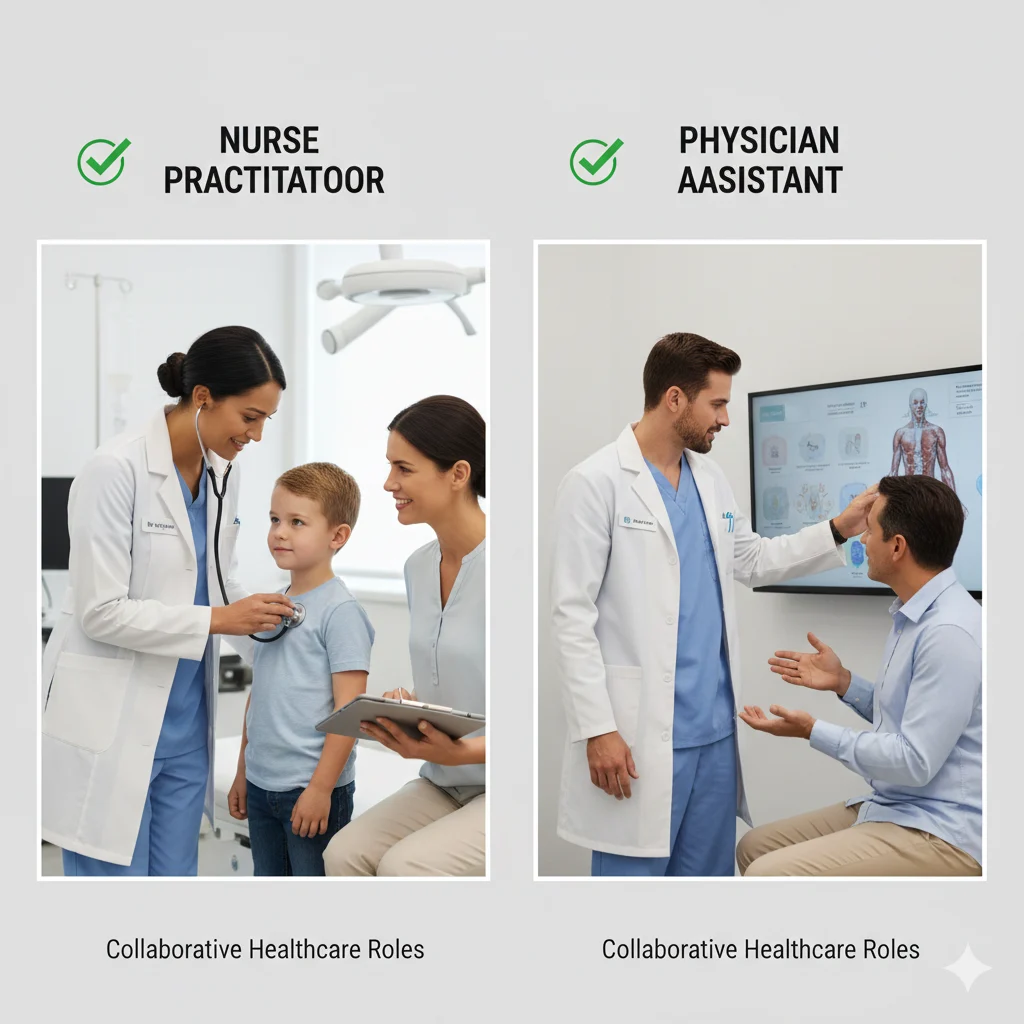
Quick Tip to Remember
- NP = Nurse → Practitioner
(Starts as a nurse, then advances.) - PA = Physician → Assistant
(Works closely with doctors.)
If you remember that NP comes from nursing and PA comes from medicine, you’ll never mix them up again!
Common Mistakes and How to Avoid Them
Let’s look at some common errors people make when talking about NP or PA — and how to fix them.
❌ Mistake 1: Saying NP and PA are the same job
Wrong:
An NP and PA do exactly the same thing.
✅ Correct:
An NP and PA both treat patients, but they have different training and backgrounds.
Why this happens:
They both wear white coats and help patients, so people think their jobs are identical.
How to fix it:
Remember: NPs come from nursing. PAs come from medical training.
❌ Mistake 2: Thinking only doctors can prescribe medicine
Wrong:
Only doctors can give medicine. NPs and PAs cannot.
✅ Correct:
Both NPs and PAs can prescribe medicine in most places.
Why this happens:
Many people don’t realize how advanced NP and PA training is.
How to fix it:
Know that both roles are licensed professionals who can treat patients safely.
❌ Mistake 3: Calling a PA a “nurse”
Wrong:
The PA is a nurse.
✅ Correct:
The PA is a medical professional trained to work with doctors, not a nurse.
Why this happens:
People confuse all healthcare workers in scrubs as nurses.
How to fix it:
Remember: PA is not a nurse. NP is.

When to Use NP
You should use NP when talking about a Nurse Practitioner — a healthcare professional who started as a nurse and gained advanced training.
Situations Where NP Is Used
- Family clinics
- Women’s health visits
- Child check-ups
- Chronic illness care (like diabetes or asthma)
- Wellness and prevention visits
Easy Examples of NP in Sentences
- The NP gave me advice about eating healthy food.
- I see a nurse practitioner for my yearly physical exam.
- The NP helped my mom manage her blood pressure.
- At the clinic, the NP listened carefully to my symptoms.
- The nurse practitioner explained how to take my medicine.
Real-Life Example
Imagine this:
You go to a clinic because you have a fever and sore throat. Instead of a doctor, you meet an NP. She checks your throat, asks questions, and gives you medicine. She also teaches you how to rest and drink fluids. That’s a Nurse Practitioner at work.
When to Use PA
You should use PA when talking about a Physician Assistant — a medical professional trained to diagnose and treat patients while working closely with doctors.
Situations Where PA Is Used
- Hospitals
- Emergency rooms
- Surgery centers
- Orthopedic clinics
- Urgent care clinics
Easy Examples of PA in Sentences
- The PA examined my broken arm and ordered an X-ray.
- A physician assistant helped during my surgery.
- The PA explained my test results before the doctor came in.
- At the hospital, the PA checked my vital signs and symptoms.
- The PA prescribed medicine for my infection.
Memory Trick
Think:
PA = Partner to the doctor
They work side by side with doctors to treat patients.
NP vs PA in Daily Life: Simple Scenarios
Let’s look at some easy real-life situations.
Scenario 1: School Health Check
A student needs a physical exam for sports.
- An NP might do the exam, check heart rate, ask about health history, and sign the form.
- A PA might do the same exam in a sports clinic or hospital setting.
Both can help — but their training paths are different.
Scenario 2: Emergency Room Visit
You fall and cut your arm badly.
- A PA might clean the wound, stitch it, and prescribe medicine.
- A doctor may supervise or work nearby.
Scenario 3: Family Doctor Visit
You go for a regular check-up.
- An NP might take care of the visit, give health advice, and order blood tests.
NP vs PA: Education Made Simple
Let’s break down their education in a way even a child can understand.
How Does Someone Become an NP?
- First, they become a nurse.
- Then, they go back to school for advanced nursing.
- They learn how to diagnose and treat patients.
- They earn the title Nurse Practitioner.
Think of it like leveling up in a game.
Nurse → Advanced Nurse → Nurse Practitioner.
How Does Someone Become a PA?
- They study science and medicine.
- They go to PA school, which is similar to medical school.
- They learn how to diagnose illnesses and treat patients.
- They work with doctors as Physician Assistants.
Think of it like training to be a doctor’s teammate.
Can NPs and PAs Work Without Doctors?
This is a common question.
Nurse Practitioners
In many places, NPs can work independently. This means they can:
- Run clinics
- See patients alone
- Prescribe medicine without a doctor nearby
Physician Assistants
PAs usually work with a doctor. They can still see patients on their own, but a doctor supervises their work.
NP vs PA in Simple Words
Let’s explain this like you’re in grade 4.
- NP: A nurse who studied more and can now act like a doctor in many ways.
- PA: A medical helper trained to work with doctors to treat patients.
Both help people feel better. Both are important. Neither is “better” — they just work differently.
Quick Recap: NP vs PA
Here’s a short and clear summary:
- NP means Nurse Practitioner.
- PA means Physician Assistant.
- NPs start as nurses.
- PAs start in medical training.
- Both can:
- Examine patients
- Diagnose illness
- Order tests
- Prescribe medicine
- NPs often focus on long-term care and wellness.
- PAs often work in hospitals and emergency settings.
Advanced Tips (Optional)
A Short History
- The NP role began in the 1960s to help improve access to healthcare, especially in small towns.
- The PA role also started around the same time to help doctors treat more patients, especially after wars when many medical helpers were needed.
In Exams and Formal Writing
In school essays or healthcare exams:
- Use Nurse Practitioner (NP) on first mention, then NP after that.
- Use Physician Assistant (PA) on first mention, then PA.
Example:
The Nurse Practitioner (NP) provided patient education. The NP also prescribed medication.
In Texting and Online Writing
Sometimes people confuse:
- PA with “personal assistant”
- NP with “no problem”
In healthcare writing, always make sure your meaning is clear by adding the full term the first time.
Mini Quiz: Test Your Understanding
Fill in the blanks with NP or PA.
- The _____ checked my blood pressure and gave me advice about healthy eating.
- The _____ helped the doctor during surgery.
- I see a _____ at the clinic for my yearly check-up.
- The _____ stitched my cut in the emergency room.
- A _____ is trained through nursing.
- A _____ works closely with doctors in hospitals.
Answers
- NP
- PA
- NP
- PA
- NP
- PA
Great job if you got most of them right! 🎉
Frequently Asked Questions (FAQs)
1. What is the main difference between NP and PA?
The main difference is their training background. NPs start as nurses and focus on patient-centered care. PAs train in medicine and work closely with doctors.
2. Can both NPs and PAs prescribe medicine?
Yes. In most places, both Nurse Practitioners and Physician Assistants can prescribe medications.
3. Who earns more: NP or PA?
Salaries vary by location, experience, and workplace. In many areas, NPs and PAs earn similar pay.
4. Can I see an NP instead of a doctor?
Yes. Many people see NPs for regular check-ups, illnesses, and long-term care. In many places, NPs can work independently.
5. Are PAs doctors?
No. PAs are not doctors, but they are highly trained medical professionals who work closely with doctors to treat patients.
Conclusion
Now you clearly understand the difference between NP and PA. An NP is a Nurse Practitioner — a nurse with advanced training who focuses on patient care and wellness. A PA is a Physician Assistant — a medical professional trained to work with doctors to diagnose and treat illness. Both roles are important. Both help people get better. And both deserve respect for the work they do every day.
The next time you see NP or PA on a badge or clinic door, you’ll know exactly what it means. Keep learning, keep practicing, and remember — improving your English and knowledge happens one small step at a time. 🌟
Elizabeth Gaskell was a Victorian English novelist and biographer, celebrated for social realism, strong female characters, and industrial age themes. era life.