Many people often get confused between never mind and nevermind. At first glance, they look almost identical, but using them incorrectly can change the meaning of a sentence or make it sound awkward. Whether you’re texting friends, writing an email, or learning English as a second language, understanding the difference is essential.
In this guide, you’ll learn the meaning of both never mind and nevermind, their correct usage, and simple tips to remember which one to use. We’ll also cover common mistakes, real-life examples, and a quick quiz to test your understanding. By the end, even beginners will feel confident using these expressions in everyday English.
What Does Each Word Mean?
1. Never Mind
Meaning:
Never mind is a phrase used to tell someone not to worry about something, to ignore a previous statement, or to cancel a request. It is usually two separate words.
Part of Speech:
- Phrase (interjection)
- Sometimes used in informal conversation as a polite way to retract a statement.
Examples:
- “Oh, you forgot your homework? Never mind, you can submit it tomorrow.”
- “Never mind what I said earlier — it’s not important.”
- “I was going to ask for help, but never mind, I figured it out myself.”
Memory Tip: Think of it as two words: “never” + “mind.” You are literally saying, “Don’t pay attention to it in your mind.”
2. Nevermind
Meaning:
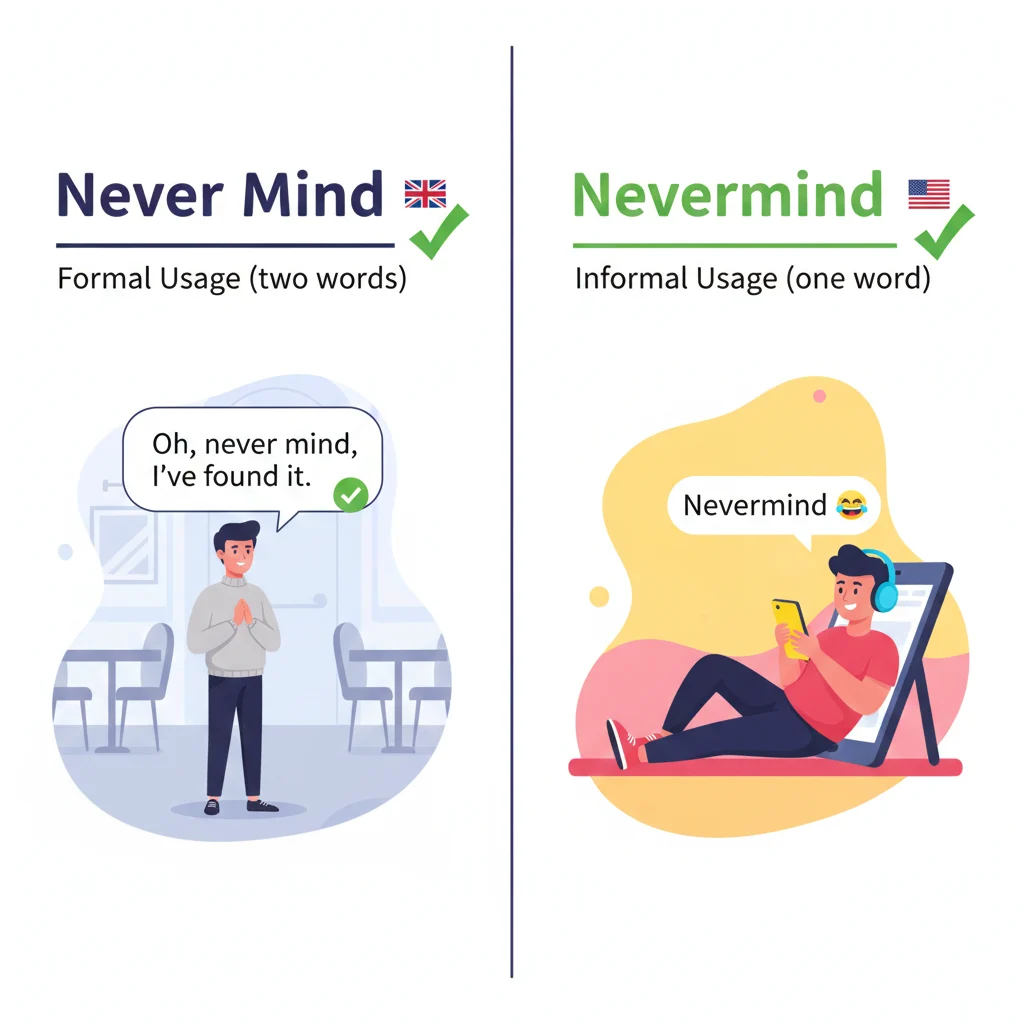
Nevermind (one word) is often considered an informal spelling of never mind, mostly used in casual writing or texts. Some dictionaries accept it, but in formal writing, never mind is preferred.
Part of Speech:
- Phrase (interjection), informal
- Can also be used as a noun in rare cases (e.g., song or brand names).
Examples:
- “Nevermind, I don’t need your help after all.”
- “He tried to explain, but she just said ‘nevermind.’”
- “Nevermind the mistake — let’s move on.”
Memory Tip: If you’re texting or chatting informally, one word is fine. In school essays or professional emails, use the two-word version: never mind.
The Key Difference Between Never Mind and Nevermind
| Feature | Never Mind | Nevermind |
|---|---|---|
| Meaning | Tell someone not to worry; cancel a statement | Informal spelling of never mind; casual use |
| Spelling | Two words | One word |
| Formality | Correct in formal writing | Informal, casual, or texting |
| Example | “Never mind what I said.” | “Nevermind, it’s fine.” |
| Use Tip | Use when speaking politely or writing formally | Use in messages, social media, or casual notes |
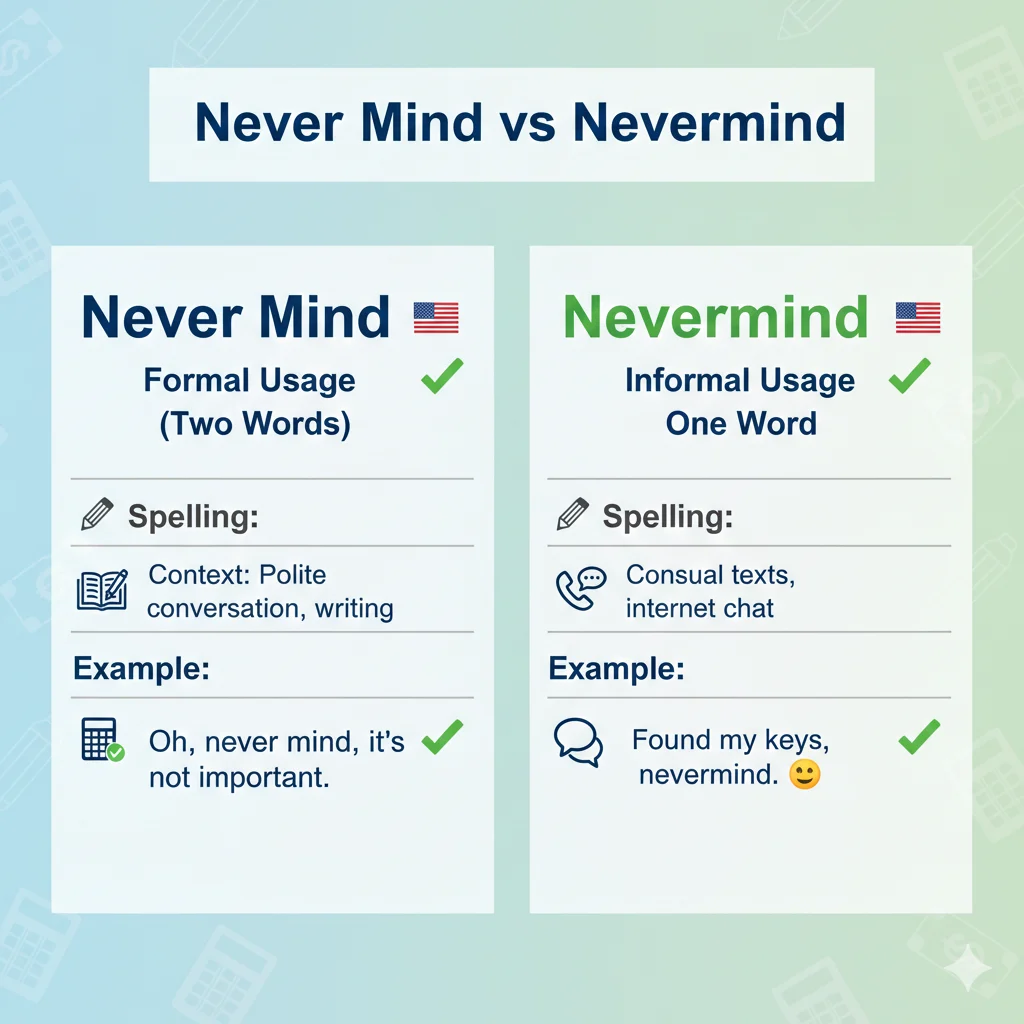
Quick Tip: Remember, never mind = standard, formal; nevermind = casual, informal. When in doubt, always choose the two-word version.
Ambience or Ambiance: Meaning, Difference, and Correct Usage
Common Mistakes and How to Avoid Them
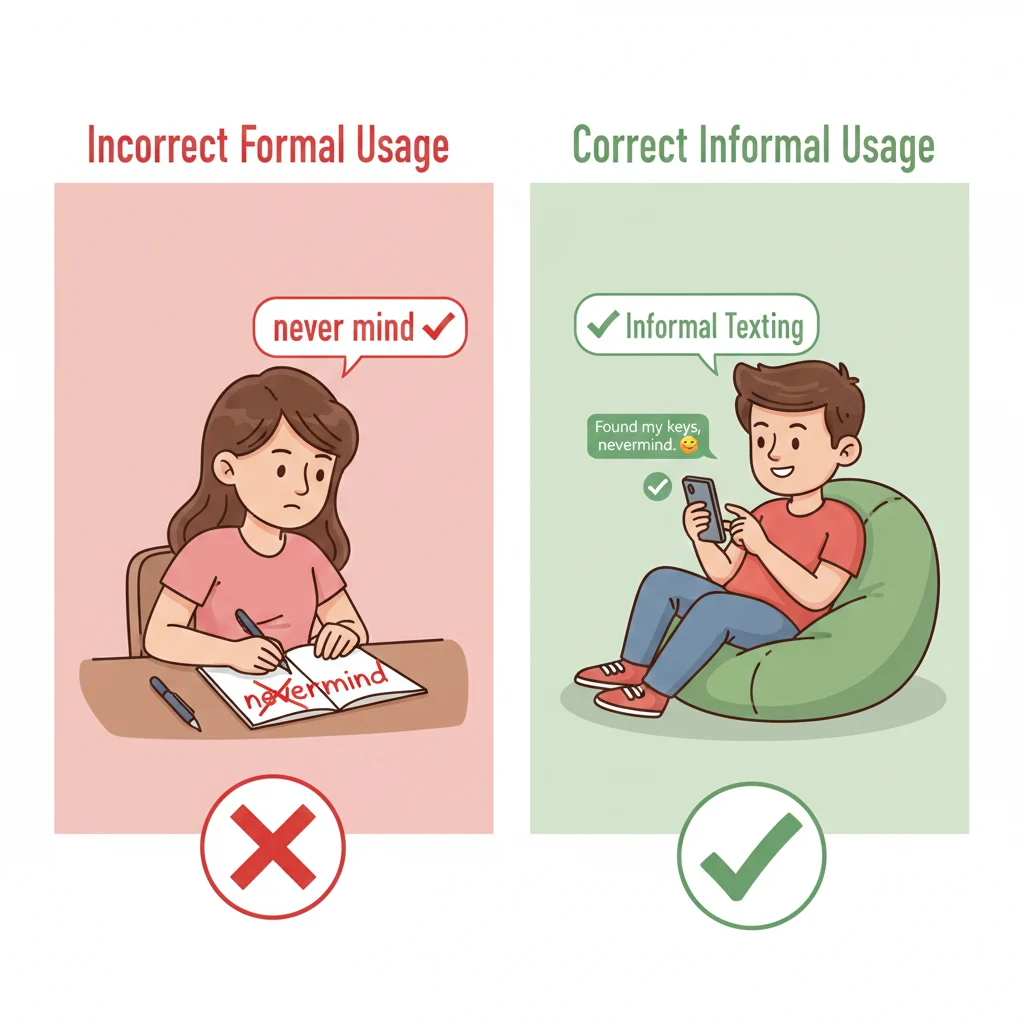
Mistake 1: “Nevermind what I said.” (Incorrect in formal writing)
Correction: “Never mind what I said.”
Mistake 2: Using never mind as a single word in school essays.
Correction: Stick with never mind in essays, reports, and professional writing.
Why It Happens:
People often merge the words in informal speech and texting, which is fine casually but incorrect in formal contexts.
Fix: Remember the rule: two words for formal English, one word for informal texting.
When to Use Never Mind
Never mind is versatile and can be used in everyday situations. Here are common examples:
- Canceling a request: “Never mind, I found my keys.”
- Telling someone not to worry: “Never mind, it’s not a big deal.”
- Ignoring a previous statement: “Never mind what I said before, let’s focus on the task.”
- Polite refusal: “Never mind, you don’t have to help me.”
- Correcting a misunderstanding: “Never mind, I misunderstood the question.”
Real-Life Tip: Imagine you are teaching a friend something, then you realize it’s unnecessary. Saying never mind politely cancels your instruction.
When to Use Nevermind
Nevermind works best in casual conversations, texting, or informal online writing. Examples:
- “Nevermind, I’ll do it myself.”
- “He wanted to come, but nevermind, he changed his mind.”
- “Nevermind the noise outside — focus on your homework.”
- “I was going to explain, but nevermind.”
Memory Hack: Think of texting friends. You’re saying it quickly, so one word fits naturally: nevermind.
Quick Recap: Never Mind vs Nevermind
- Never mind: Two words, formal, polite, standard English. Use in writing, essays, or professional contexts.
- Nevermind: One word, informal, casual, used in texts or chatting.
- Rule of thumb: Two words for formality, one word for casual conversations.
- Tip: When unsure, choose never mind. It is always safe.
Advanced Tips
- Origin: Never mind comes from Middle English, meaning “do not concern yourself.” Over time, nevermind became common in texting and song titles.
- Formal Writing: Always use never mind. Example: “Never mind the delays; the project will still finish on time.”
- Online Use: Nevermind is widely accepted in texting and informal posts but can be flagged in professional documents.
- Pop Culture Note: Nevermind is famously used in album titles (e.g., Nirvana), which is an exception to grammar rules.
Lended or Lent: Which One Is Actually Correct?
Mini Quiz: Test Your Knowledge
Fill in the blanks with never mind or nevermind:
- “___, I found the answer myself.”
- “He tried to help, but ___, it’s okay.”
- “___ what I said earlier, it’s not important.”
- “___, I don’t feel like going out tonight.”
- “She started explaining, but I said ___.”
Answers:
- Never mind
- Nevermind
- Never mind
- Nevermind
- Never mind
FAQs
1. Can I use “nevermind” in formal writing?
No, use never mind in essays, emails, and professional writing. Nevermind is informal.
2. Are “never mind” and “nevermind” interchangeable?
In casual conversation or texting, yes. In formal contexts, always use never mind.
3. What does “never mind” mean in English?
It means “don’t worry about it” or “ignore what I just said.”
4. Is “nevermind” wrong?
Not always — it’s acceptable in casual or informal contexts but considered incorrect in formal writing.
5. How can I remember the difference?
Think of two words = formal, one word = informal/texting. When in doubt, use never mind.
Conclusion
Now you know the difference between never mind and nevermind. One is formal and polite, the other is casual and quick for texting. Remembering the right usage is simple: two words for writing and one word for chatting. Practicing these examples in real life will make you confident in everyday conversations, emails, and schoolwork. Keep using English daily, and you’ll see your skills improve steadily.

Elizabeth Gaskell was a Victorian English novelist and biographer, celebrated for social realism, strong female characters, and industrial age themes. era life.