Many people get confused between indexes or indices in English. These two words are often used in academic, financial, and everyday contexts, but knowing which one to choose can be tricky. Both words are plural forms related to the word “index,” but they appear in different situations.
In this guide, you will learn the meaning of indexes and indices, their correct usage, and practical examples. We’ll make it simple and clear, even for beginners. By the end, you will be able to use these words correctly in school, office writing, or casual conversation without hesitation.
What Does Each Word Mean?
Indexes
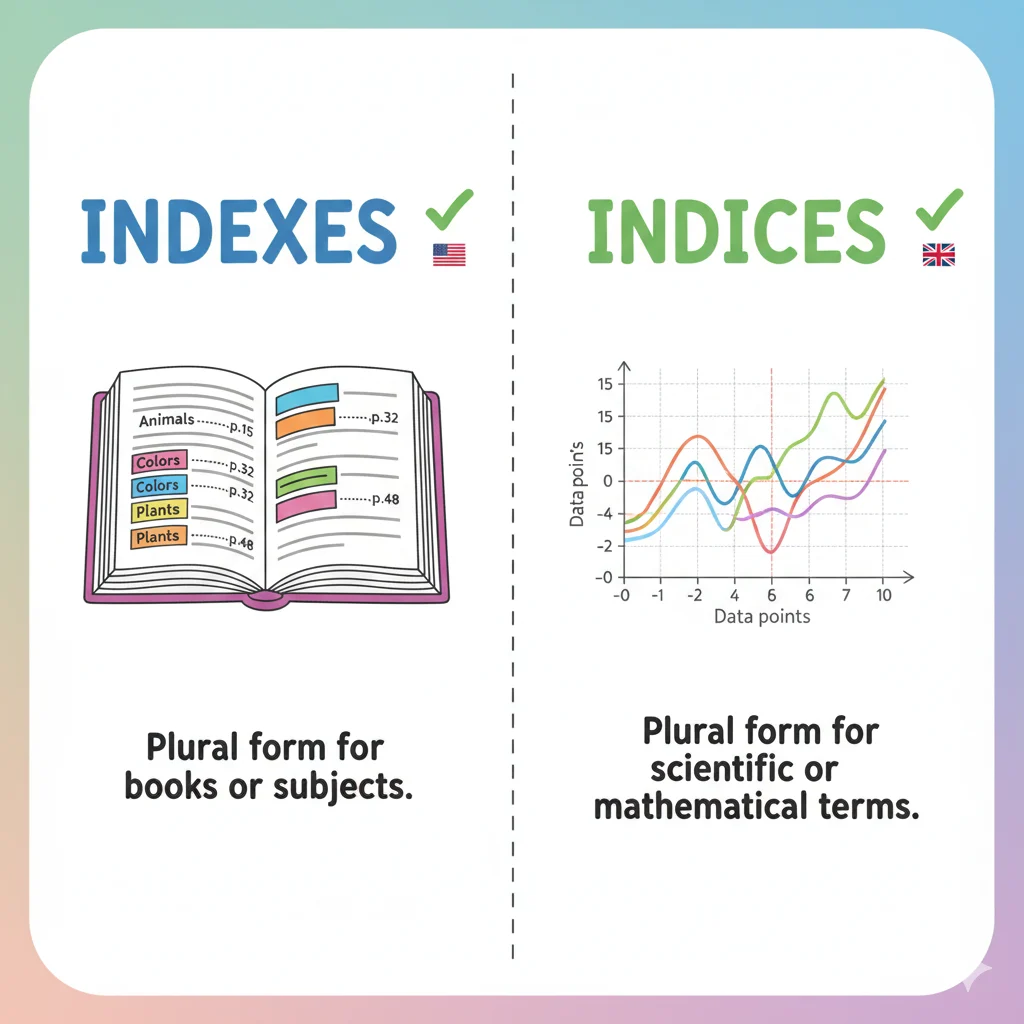
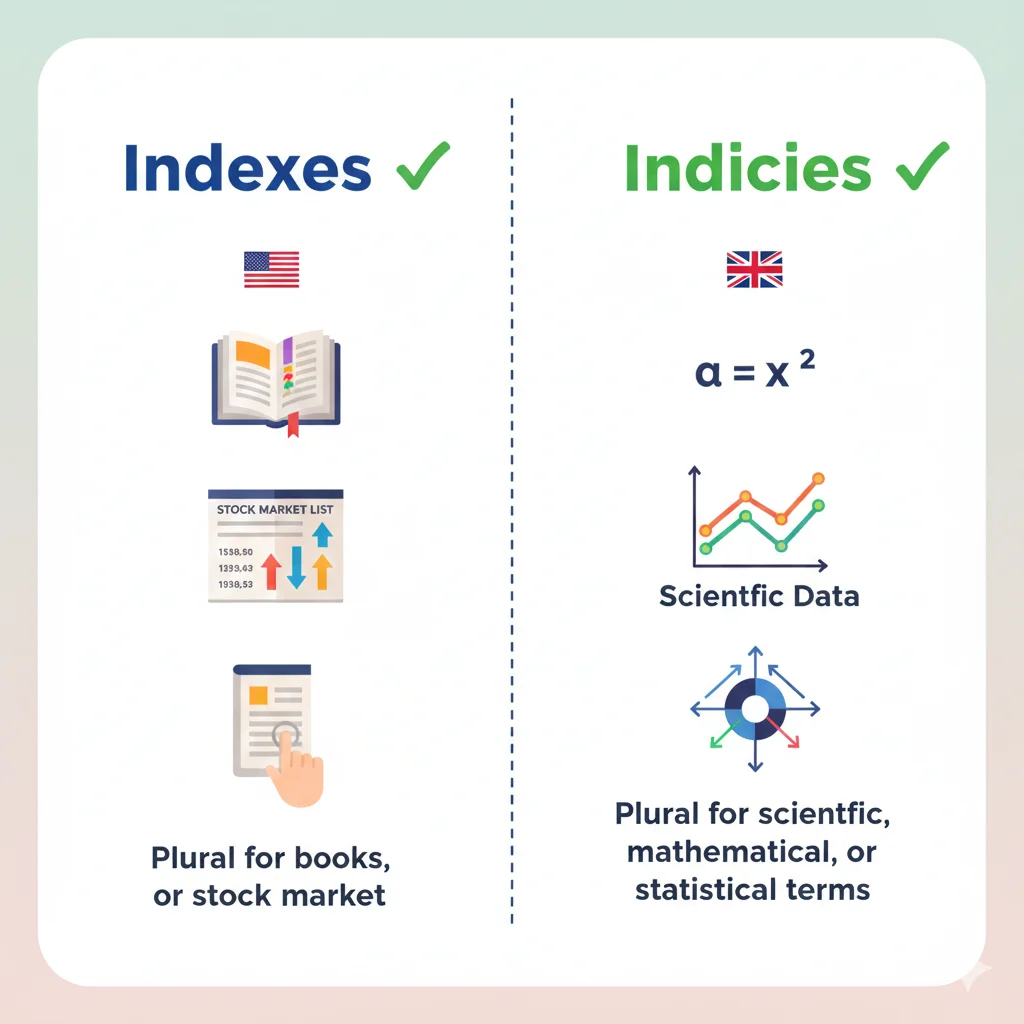
Meaning: “Indexes” is the standard plural form of the word index. An index usually refers to a list, a table, or a reference system.
Part of Speech: Noun
Examples:
- The book has detailed indexes at the back to find topics quickly.
- Stock market indexes show how the market is performing.
- The library keeps a list of all books in its indexes.
Memory Tip: Think of “indexes” as everyday lists or guides you can read easily.
Indices
Meaning: “Indices” is the Latin-derived plural of index. It is often used in mathematical, scientific, or technical contexts.
Part of Speech: Noun
Examples:
- The teacher explained how to calculate the growth indices of the population.
- Temperature and rainfall indices help scientists predict weather patterns.
- The company uses economic indices to analyze trends.
Memory Tip: Use indices for numbers, formulas, and scientific reports.
The Key Difference Between Indexes and Indices
| Feature | Indexes | Indices |
|---|---|---|
| Meaning | Lists, tables, references | Mathematical or scientific measures |
| Usage | Everyday English, books, finance | Technical, scientific, academic |
| Example Sentence | “Check the indexes at the end of the book.” | “Economic indices show growth trends.” |
| Quick Tip | If it’s a simple list or reference, use indexes | If it involves math or science, use indices |
Common Mistakes and How to Avoid Them
Mistake 1:
- Incorrect: The scientist checked the stock market indices.
- Correct: The scientist checked the stock market indexes.
- Why: Stock market lists are considered general references, not scientific calculations.
Mistake 2:
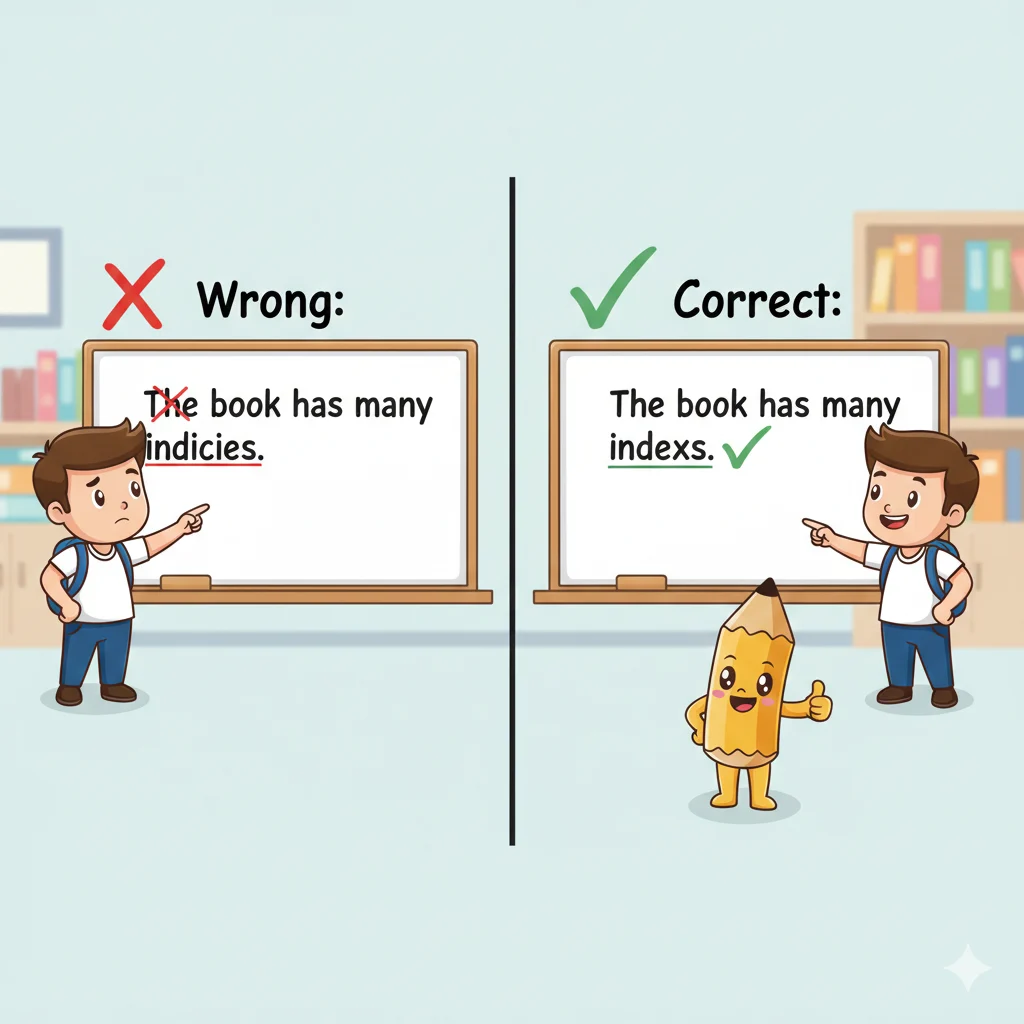
- Incorrect: I used the book’s indices to find the topic.
- Correct: I used the book’s indexes to find the topic.
- Why: A book index is everyday English, not technical.
Mistake 3:
- Incorrect: Scientists calculated the city’s traffic indexes.
- Correct: Scientists calculated the city’s traffic indices.
- Why: Traffic calculations involve technical measurements, so indices is correct.
When to Use Indexes
You should use indexes in situations like lists, references, or everyday applications.
Examples:
- The library keeps indexes of all new arrivals.
- I looked through the recipe book’s indexes to find desserts.
- Financial magazines often publish stock indexes.
- The dictionary’s indexes help students locate words quickly.
- The museum has indexes of all paintings on display.
Memory Hack: Whenever you can physically flip through a list or table, it’s probably an index.
When to Use Indices
Use indices when referring to measurements, numbers, or scientific data.
Examples:
- Economists compare GDP growth using different indices.
- Scientists track climate change using temperature and rainfall indices.
- The teacher taught us how to calculate population indices.
- Researchers use health indices to evaluate public wellness.
- Engineers measure stress levels using material strength indices.
Memory Trick: If it involves formulas, calculations, or graphs, indices is your word.
Quick Recap: Indexes vs Indices
- Indexes: Lists, guides, or references; everyday English.
- Indices: Numerical or scientific measures; technical contexts.
- Tip: Flip through a book? Use indexes. Use math or science? Use indices.
- Mistakes to Avoid: Mixing general references with technical terms.
Advanced Tips
- Origin: “Indexes” comes from Old French and English, while “indices” is Latin-based.
- Formal Writing: Use indices in essays, scientific reports, or research papers. Indexes is more common in books, libraries, and finance.
- Online Writing: Using the wrong word can confuse readers. Avoid saying “book indices” instead of “book indexes.”
Mini Quiz
Fill in the blanks with indexes or indices:
- The library has well-organized ________ to find books quickly.
- Scientists study rainfall ________ to predict floods.
- The financial magazine released the latest stock market ________.
- Engineers calculate material strength using safety ________.
- The history textbook includes detailed chapter ________.
Answers:
- indexes
- indices
- indexes
- indices
- indexes
FAQs
1. Can I use indexes and indices interchangeably?
Not always. Use indexes for everyday lists and indices for scientific or technical data.
2. Which is more formal: indexes or indices?
Indices is more formal, especially in academic or technical contexts.
3. How do I remember the difference?
Think “indexes for everyday lists, indices for numbers and calculations.”
4. Is indices correct in finance?
It depends. Stock market indexes is standard in finance; technical indices are rare in finance.
5. Can a book have indices?
It’s uncommon. Books usually have indexes, not indices.
Conclusion
Now you know the difference between indexes and indices. Indexes are for everyday lists, references, and finance, while indices belong to scientific, mathematical, and technical contexts. By practicing the examples and tips in this guide, you can confidently use both words correctly in writing and speaking. Remember, learning English is a journey, and mastering small details like this makes a big difference. Keep practicing, and you’ll get it right every time!

Elizabeth Gaskell was a Victorian English novelist and biographer, celebrated for social realism, strong female characters, and industrial age themes. era life.