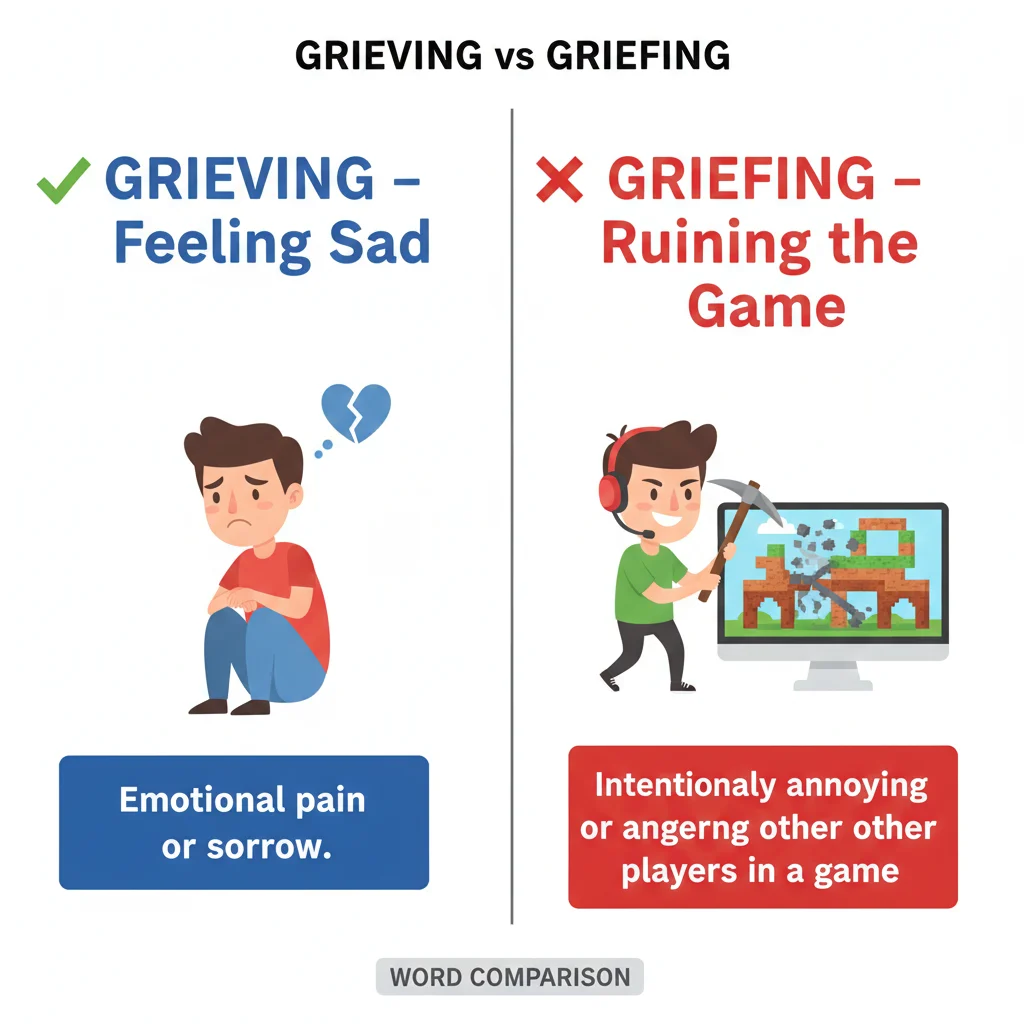
Many English learners get confused between griefing or grieving. The words look almost the same. They sound similar too. But their meanings are very different.
If you mix them up, your sentence can change completely. For example, saying “He is griefing his loss” is not the same as “He is grieving his loss.” One is correct. The other is a mistake.
In this simple guide, you will learn:
- The meaning of each word
- The difference between griefing and grieving
- The correct usage with easy examples
- Common mistakes and how to avoid them
Don’t worry. This explanation is written in very easy English. Even a young student can understand it. Let’s begin.
What Does “Grieving” Mean?
Grieving comes from the word grieve. It is a verb.
It means feeling deep sadness, especially when someone dies or when you lose something important.
When someone is grieving, they are feeling emotional pain.
Simple Definition
Grieving means feeling very sad because of a loss.
Part of Speech
- Verb (present participle of “grieve”)
Easy Examples
- She is grieving after her grandmother passed away.
- He is grieving the loss of his pet dog.
- They are grieving because their house was destroyed in a fire.

Short Story to Remember
Imagine a girl whose best friend moves to another country. She cries every day and misses her friend. She feels heavy inside. That feeling is called grieving.
Grieving is about sadness and emotional pain.
What Does “Griefing” Mean?
Griefing is a very different word.
It is mostly used in the world of online games.
In gaming, griefing means intentionally annoying or harming other players just to spoil their fun.
It does not usually mean sadness.
Simple Definition
Griefing means causing trouble for others on purpose, especially in video games.
Part of Speech
- Verb (from the slang word “grief” used in gaming)

Easy Examples
- The player was griefing by destroying his teammate’s buildings.
- Stop griefing and let others enjoy the game.
- He got banned for griefing other players online.
Short Story to Remember
Imagine a boy playing an online building game. Instead of playing nicely, he breaks other players’ houses just to make them angry. That is called griefing.
Griefing is about causing trouble on purpose.
The Key Difference Between Griefing and Grieving
Now let’s clearly see the difference between griefing and grieving.
| Feature | Grieving | Griefing |
|---|---|---|
| Meaning | Feeling deep sadness | Intentionally annoying or harming others (usually in games) |
| Emotion | Sadness and pain | Mischief or bad behavior |
| Used In | Real life, emotional situations | Online games, gaming communities |
| Example Sentence | She is grieving her father’s death. | He was griefing players in the match. |

Quick Tip to Remember
- Grieving = Crying (sad feelings)
- Griefing = Gaming (bad behavior in games)
Notice the word “game” inside your memory trick. Griefing is mostly about games.
That simple trick can help you choose the correct word.
Common Mistakes and How to Avoid Them
Many learners make mistakes because the words look similar. Let’s fix some common errors.
Mistake 1
❌ He is griefing his mother’s death.
✅ He is grieving his mother’s death.
Why?
When someone dies, we feel sad. That feeling is grieving, not griefing.
Mistake 2
❌ She was grieving other players in the game.
✅ She was griefing other players in the game.
Why?
In games, if someone is bothering others on purpose, that is griefing.
Mistake 3
❌ The whole country was griefing after the disaster.
✅ The whole country was grieving after the disaster.
Why?
A disaster causes sadness. Sadness equals grieving.
How to Avoid These Mistakes
Ask yourself one simple question:
👉 Is this about sadness and loss?
If yes, use grieving.
👉 Is this about annoying others in a game?
If yes, use griefing.
That’s the grammar rule in simple words.
When to Use “Grieving”
You should use grieving when talking about:
- Death of a loved one
- Losing a pet
- Losing something very important
- Feeling emotional pain
Real-Life Examples
- The family is grieving their loss.
- She is grieving after losing her job.
- He is still grieving his childhood friend.
- Many people were grieving after the accident.
- The child is grieving because her cat ran away.
In schools, essays, and formal writing, grieving is common. It is a serious word. It talks about real feelings.
Memory Hack
Think of this sentence:
Grieving makes you cry.
If crying and sadness are involved, you need grieving.
When to Use “Griefing”
Use griefing when talking about:
- Online games
- Multiplayer games
- Players who ruin the game for others
- Breaking game rules on purpose
Simple Examples
- He was banned for griefing.
- Stop griefing your teammates.
- The moderator warned players about griefing.
- Griefing can make the game unfair.
- Many games have rules against griefing.
This word is informal. It is mostly used in gaming communities and online chats. You will not often see it in school essays unless you are writing about video games.
Visual Trick
Remember:
🎮 Griefing = Game trouble
💔 Grieving = Heart trouble
One is about games. The other is about feelings.
Quick Recap: Griefing vs Grieving
Here is a short and easy summary:
- Grieving means feeling deep sadness.
- Griefing means causing trouble in games.
- Grieving is about emotions.
- Griefing is about bad behavior in gaming.
- If someone dies, you grieve.
- If someone destroys your game world on purpose, they grief.
This simple comparison makes the difference between griefing and grieving very clear.
Advanced Tips for Better Understanding
Word Origin
The word grieving comes from old English words related to sorrow and pain. It has been used for hundreds of years.
The word griefing is modern slang. It became popular with online games and multiplayer platforms.
This shows why their meanings are so different.
In Formal Writing
- Grieving is correct in essays, letters, and exams.
- Griefing is usually only correct when writing about video games.
If you are writing an exam and talking about sadness, always choose grieving.
In Texting and Social Media
Sometimes people type fast and spell the wrong word. That can confuse readers.
For example:
“I am griefing my uncle.”
This sentence looks strange and wrong because griefing does not mean feeling sad.
Always double-check your spelling before sending a message.
Mini Quiz: Test Your Understanding
Fill in the blanks with griefing or grieving.
- She is still ________ her grandmother’s death.
- The player was banned for ________.
- They were ________ after losing their home.
- Stop ________ and play fairly.
- He is ________ the loss of his best friend.
- Many games have rules against ________.
Answers
- grieving
- griefing
- grieving
- griefing
- grieving
- griefing
If you got them right, great job!
Frequently Asked Questions (FAQs)
1. What is the difference between griefing and grieving?
Grieving means feeling deep sadness after a loss. Griefing means intentionally annoying or harming other players in online games.
2. Is griefing a real English word?
Yes, but it is mostly gaming slang. It is commonly used in online gaming communities.
3. Is grieving only used when someone dies?
No. Grieving can also be used when someone loses a pet, a job, or something very important.
4. Can I use griefing in formal writing?
Usually no, unless you are writing about video games. It is informal.
5. Why do people confuse griefing and grieving?
They look almost the same and sound similar. But their meanings are very different.
Conclusion
Now you clearly understand the difference between griefing and grieving.
Grieving is about sadness and emotional pain. It happens when we lose someone or something important. Griefing is about causing trouble, mostly in online games.
The spelling is similar, but the meaning is not. Always check the situation before choosing the word. Ask yourself: Is this about feelings or about gaming behavior?
Keep practicing with small sentences every day. Step by step, your English will become stronger and more confident.

Wilkie Collins was a Victorian English novelist and playwright, pioneer of detective fiction and sensation novels, blending mystery, suspense, and social critique.