Many English learners — and even native speakers — feel confused about everyone and every one. They look almost the same. They sound exactly the same when spoken. So it feels natural to think they mean the same thing. But they do not always mean the same thing.
This small space between the words changes the meaning. And that small change can make a sentence right or wrong.
In this easy guide, you will learn the meaning of everyone and every one, the difference between everyone and every one, and the correct usage of both words. You will see simple examples from daily life, school, and conversations. Everything is explained in plain English so that even a 4th-grade student can understand it easily.
By the end of this article, you will feel confident choosing the correct word every time — no guessing, no confusion.
What Does Each Word Mean?
Before we compare them, let’s understand each word clearly and simply.
What Does Everyone Mean?
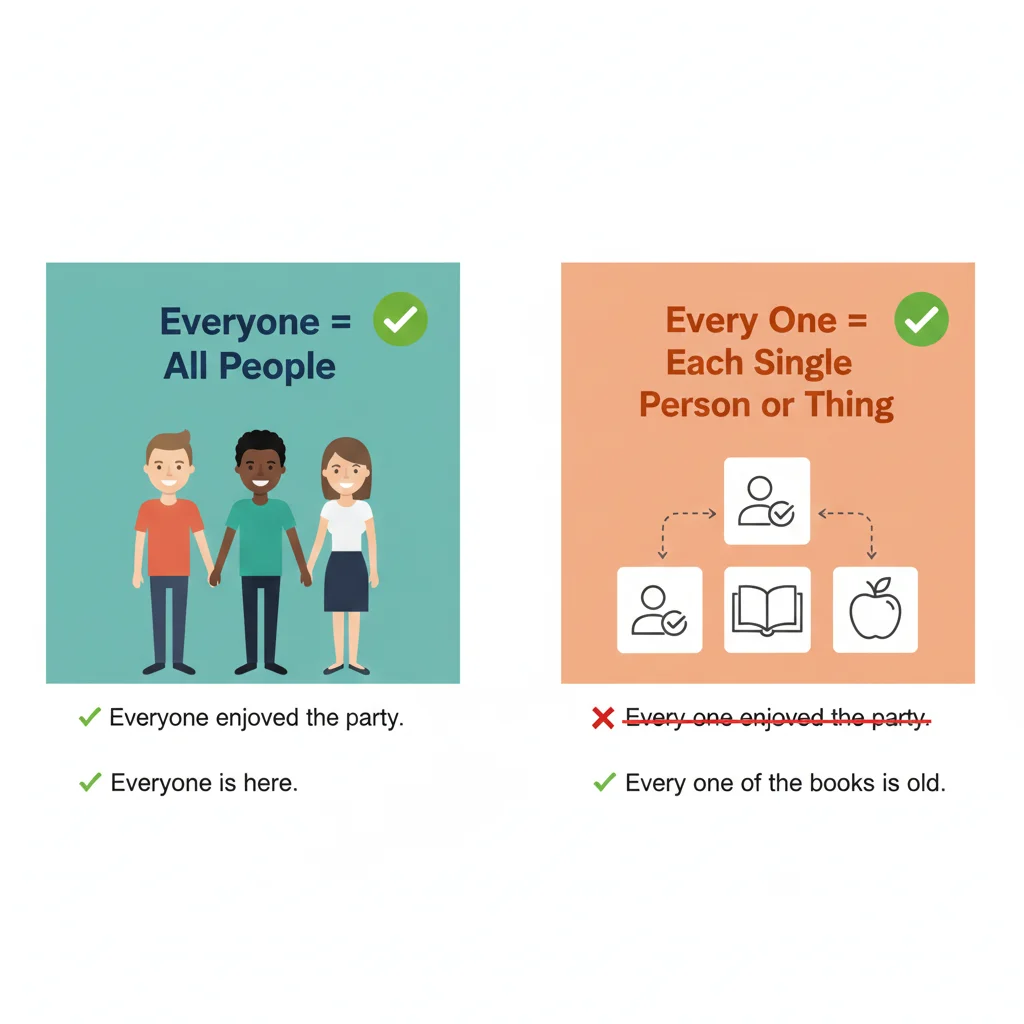
Everyone means all people in a group.
It talks only about people, not things.
It is one word. No space.
Think of everyone as meaning:
- all people
- everybody
Part of speech: Pronoun
(It replaces a noun, like “students” or “people.”)

Easy Examples of Everyone
- Everyone loves ice cream.
(All people love ice cream.) - Everyone in my class passed the test.
(All students passed.) - The teacher thanked everyone for coming.
(All people who came.)
👉 Memory tip:
If you can replace the word with “everybody”, then everyone is correct.
What Does Every One Mean?
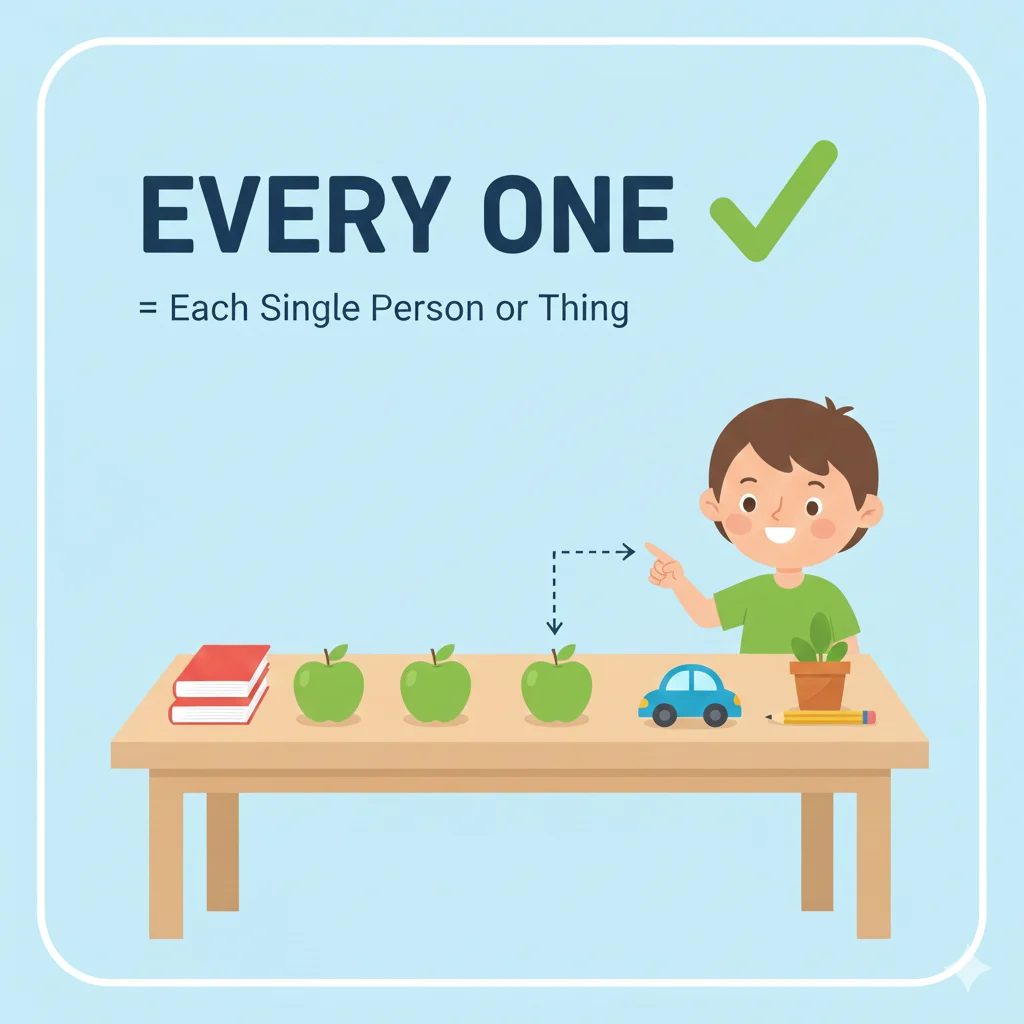
Every one means each single person or thing, one by one.
It is two words:
- every (means all)
- one (means each single item or person)
Part of speech:
- Every = determiner
- One = noun or pronoun
Unlike everyone, every one can be used for people or things.
Easy Examples of Every One
- Every one of the cookies is gone.
(Each cookie, one by one.) - I checked every one of the answers.
(Each answer.) - She greeted every one of her guests.
(Each guest, individually.)
👉 Memory tip:
If the sentence has “of” after it, you usually need every one.
The Key Difference Between Everyone and Every One
The main difference is what they talk about and how they are used.
Simple Explanation
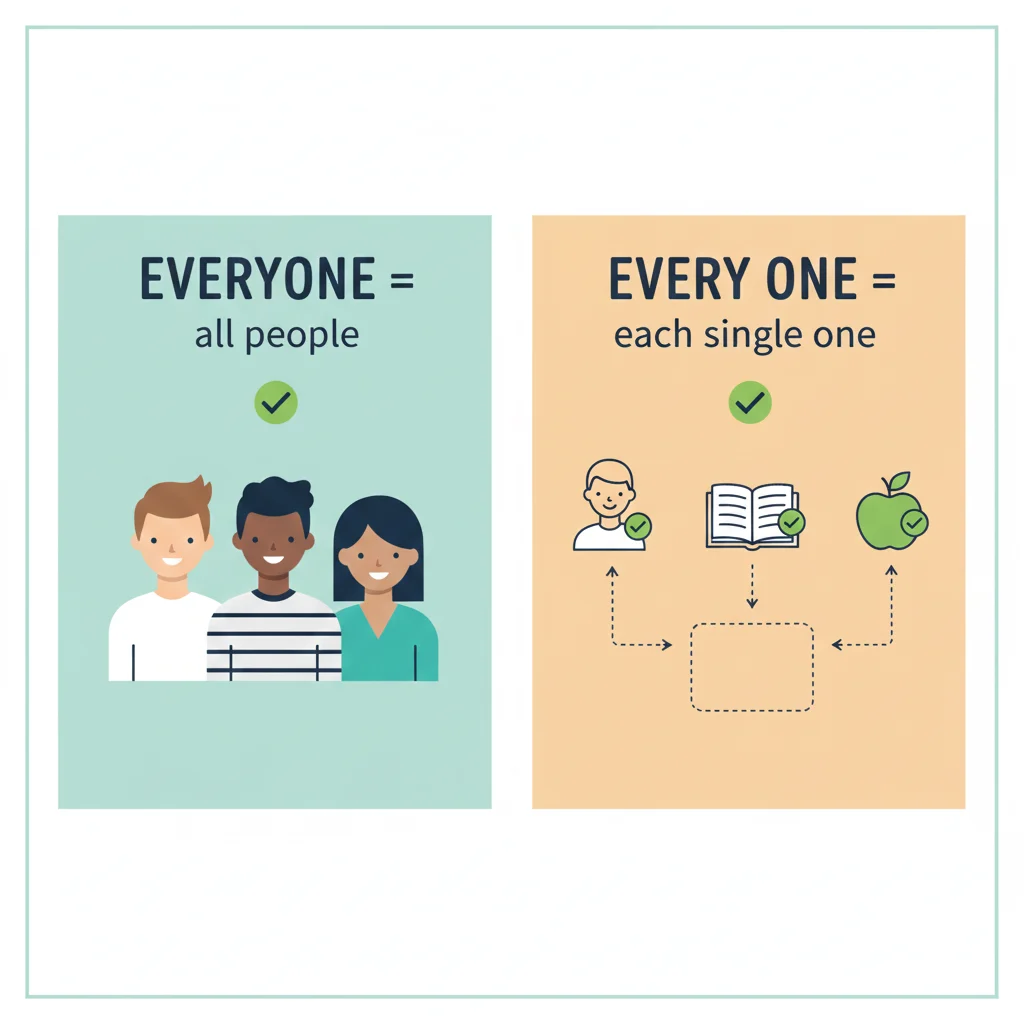
- Everyone = all people together
- Every one = each single person or thing, one at a time
Comparison Table: Everyone vs Every One
| Feature | Everyone | Every One |
|---|---|---|
| Number of words | One word | Two words |
| Talks about | Only people | People or things |
| Meaning | All people as a group | Each single person or thing |
| Followed by “of”? | ❌ No | ✅ Yes |
| Can replace “everybody”? | ✅ Yes | ❌ No |
| Example | Everyone is happy. | Every one of the toys is broken. |
Quick Tip to Remember
- If you mean all people together, use everyone.
- If you mean each one separately, use every one.
Common Mistakes and How to Avoid Them
Many people make mistakes because these words sound the same. Let’s fix the most common errors.
Mistake 1: Using Everyone for Things
❌ Everyone of the apples is fresh.
✅ Every one of the apples is fresh.
Why this is wrong:
Everyone can only be used for people. Apples are things.
Mistake 2: Using Every One When You Mean Everybody
❌ Every one is excited for the holiday.
✅ Everyone is excited for the holiday.
Why this happens:
People see “every” and think they need two words. But here, we mean all people, not each person separately.
Mistake 3: Forgetting the Word “Of”
❌ Every one the students passed.
✅ Every one of the students passed.
Rule:
Every one almost always needs “of” after it.
When to Use Everyone
Use everyone when you talk about all people in a group.
You are not focusing on each person separately.
You are talking about the group as a whole.
Common Situations for Everyone
- Talking about a class
- Talking about a family
- Talking about people at a party
- Writing stories or essays
- Daily conversations
Simple Example Sentences
- Everyone in my family loves movies.
- The coach thanked everyone after the game.
- Everyone knows the answer.
- Everyone was laughing at the joke.
- Please listen, everyone.
👉 If you can say “everybody”, then everyone is correct.
When to Use Every One
Use every one when you mean each single person or thing, one by one.
You are focusing on individual items, not the group.
Common Situations for Every One
- Counting things
- Checking items
- Talking about choices
- Talking carefully about details
Simple Example Sentences
- Every one of the books is new.
- She spoke to every one of the children.
- I looked at every one of the pictures.
- Every one of these shoes is too small.
- He thanked every one of his teachers.
Easy Memory Hack
If you can add “of them” after the words, use every one.
Quick Recap: Everyone vs Every One
- Everyone
- One word
- Means all people
- Same as everybody
- Never used for things
- Every one
- Two words
- Means each person or thing
- Often followed by of
- Used for people and things
Advanced Tips (Optional but Helpful)
Word History (Simple Version)
- Everyone comes from “every” + “one,” but over time it became one word because people used it often for groups.
- Every one stayed as two words because it keeps its exact meaning: each single one.
Use in Exams and Formal Writing
Teachers and examiners notice this mistake quickly.
Using the wrong one can change meaning and lower scores.
Formal writing prefers:
- Everyone for opinions and general statements
- Every one for facts and details
In Texting and Online Writing
Many people write quickly and forget the difference.
But in clear writing — blogs, emails, school work — using the correct form makes you look confident and skilled.
Mini Quiz: Test Your Understanding
Fill in the blanks with everyone or every one.
- ________ in the class raised their hand.
- I checked ________ of the answers twice.
- ________ loves a good story.
- She thanked ________ of her friends.
- ________ was excited about the trip.
- He counted ________ of the coins.
Answers
- Everyone
- Every one
- Everyone
- Every one
- Everyone
- Every one
Frequently Asked Questions (FAQs)
1. What is the difference between everyone and every one?
Everyone means all people.
Every one means each single person or thing.
2. Can everyone be used for objects?
No. Everyone is only for people.
Use every one for objects.
3. Is “everyone of” correct?
No.
Correct form: every one of
4. How do I remember which one to use?
- Replace with everybody → use everyone
- Add of them → use every one
5. Are everyone and everybody the same?
Yes. They mean the same thing and are used the same way.
Conclusion
Understanding the difference between everyone and every one is easier than it looks. The key is to remember what you are talking about. If you mean all people together, use everyone. If you mean each person or thing one by one, use every one.
Small grammar details like this make a big difference in clear writing and confident speaking. Keep practicing with real-life sentences. Read slowly. Think about meaning. With time, choosing the correct word will feel natural.
Elizabeth Gaskell was a Victorian English novelist and biographer, celebrated for social realism, strong female characters, and industrial age themes. era life.