Many English learners feel confused when they see the words doggy and doggie. At first glance, both words look almost the same. They even sound the same when spoken. Because of this, people often wonder: how do you spell doggy or doggie correctly?
The truth is that both spellings are used in English, but they appear in different situations and styles. Some people prefer doggy, while others write doggie. This can make it tricky for beginners, students, and even writers.
In this easy guide, you will learn the meaning of doggy and doggie, their correct usage, and the difference between them. You will also see simple examples, common mistakes, and helpful grammar tips. By the end of this article, you will clearly understand when to use doggy or doggie in writing and everyday conversation.
What Does Each Word Mean?
Meaning of “Doggy”
The word doggy is a cute and informal way to say dog. People often use it when talking to children or when describing a small or friendly dog.
It is mainly used as a noun (a name for an animal), but sometimes it can also work like an adjective.
Many people also use it in casual phrases, online conversations, or slang.
Simple examples
- The little doggy is playing in the garden.
- My sister loves every doggy she sees.
- The child pointed at the doggy picture in the book.
In casual speech, people sometimes use doggy slang to talk about dogs in a cute or playful way.
For example:
- “Look at that happy doggy!”
- “I want a doggy for my birthday.”
The plural of doggy is doggies.
Example:
- The park is full of happy doggies today.
Meaning of “Doggie”
The word doggie has the same meaning as doggy. It is also a friendly and affectionate way to say dog.
However, many writers feel that doggie looks softer or more child-friendly in spelling. That is why it is often seen in children’s books, cartoons, and playful writing.
Some people ask, “Is doggy a proper word?” The answer is yes. Both doggy and doggie are accepted informal spellings in English.
Simple examples
- The little doggie followed the boy home.
- She drew a cute doggie picture for her teacher.
- The puppy is such a sweet doggie.
Both spellings appear in online discussions too. If you check conversations about doggy or doggie Reddit, you will notice that people use both forms freely.
The Key Difference Between Doggy and Doggie
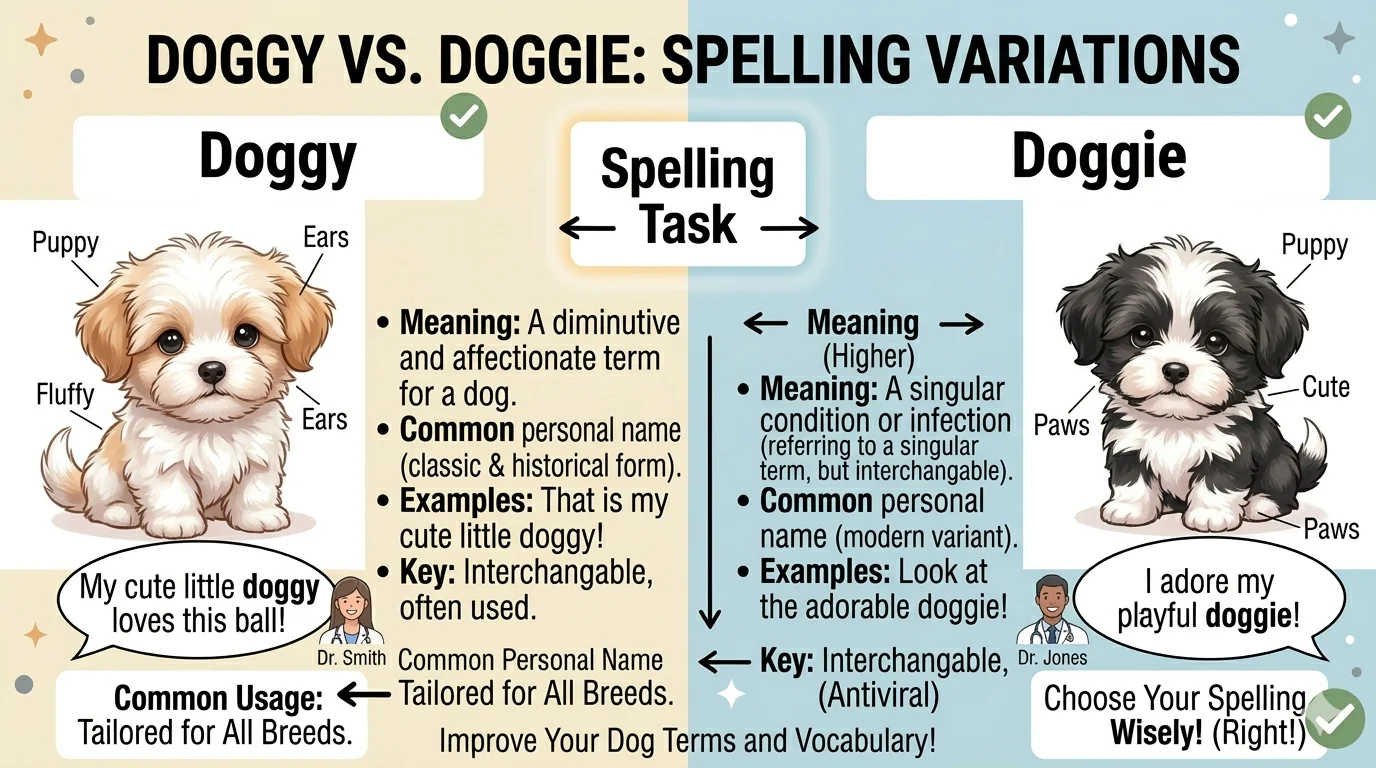
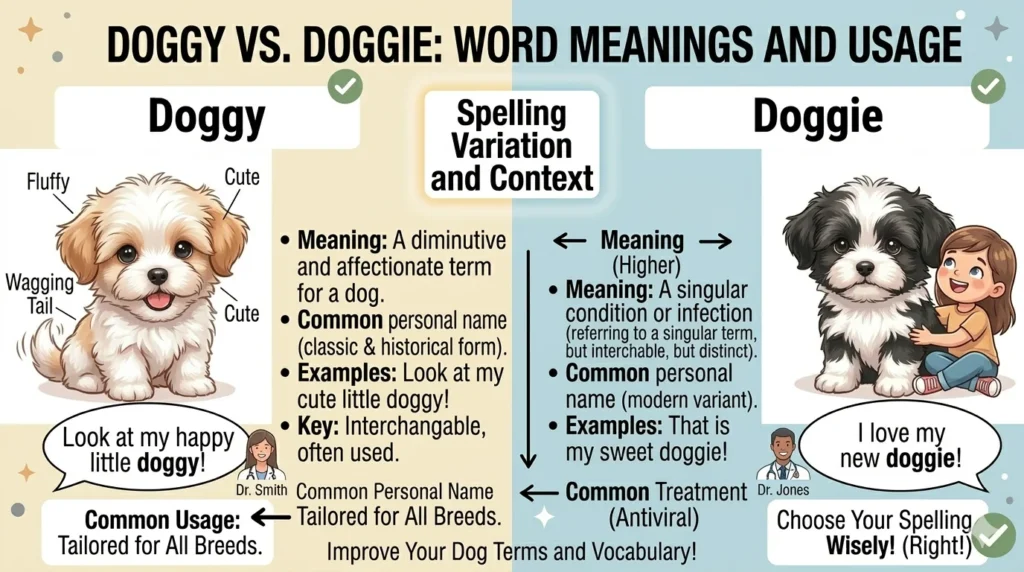
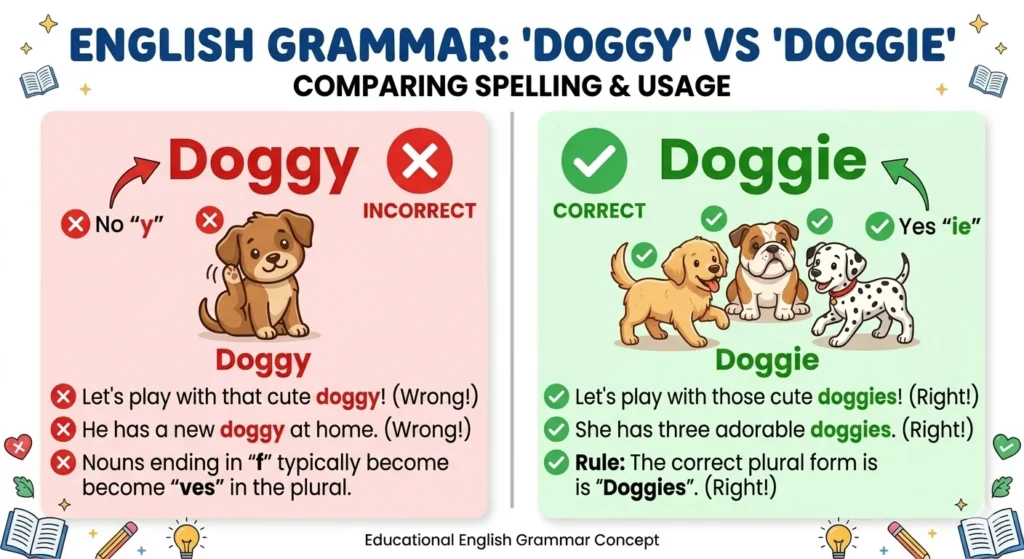
Even though these two words mean the same thing, the difference between doggy and doggie is mainly about spelling style and preference.
| Feature | Doggy | Doggie |
|---|---|---|
| Meaning | Informal word for dog | Informal word for dog |
| Tone | Casual and playful | Slightly softer or childlike |
| Common Use | Everyday speech and writing | Children’s books, cute tone |
| Example | The doggy is sleeping. | The doggie is sleeping. |
Quick Tip
If you are unsure how to spell doggy or doggie, remember this:
Doggy = more common spelling
Doggie = cuter or softer spelling
But both are correct in informal English.
Common Mistakes and How to Avoid Them
Many learners make small mistakes when using these words. Let’s look at a few examples.
Mistake 1
❌ The doggy’s are barking loudly.
✔ The doggies are barking loudly.
Explanation: The plural of doggy is doggies, not “doggy’s”.
Mistake 2
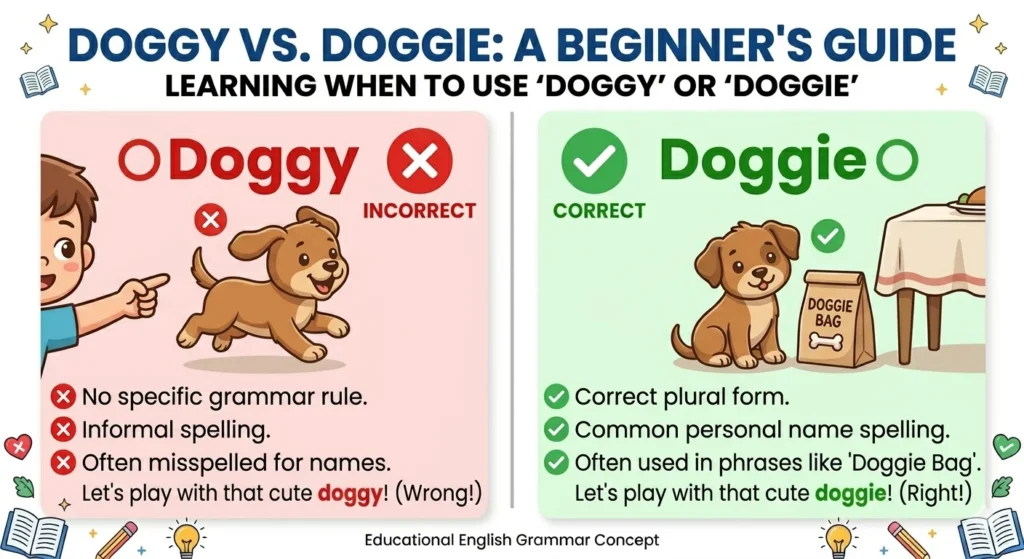
❌ She bought a doggy bag for the dog.
✔ She asked for a doggie bag after dinner.
Explanation: The correct phrase is doggie bag. It means a bag used to take leftover food home from a restaurant.
Many people ask: Is it doggy or doggie bag?
The correct and traditional phrase is doggie bag.
Mistake 3
❌ The doggie are running fast.
✔ The doggie is running fast.
Explanation: A singular noun needs a singular verb.
When to Use “Doggy”
You should use doggy when speaking casually about dogs in everyday situations.
It often appears in friendly conversations or when talking with children.
Examples in daily life
- The doggy is wagging its tail.
- My neighbor has a small white doggy.
- That doggy picture looks adorable.
- The child shouted, “Look at the doggy!”
- We saw many doggies at the park today.
Doggy Person Meaning
Sometimes people describe someone as a doggy person.
A doggy person means someone who loves dogs and enjoys spending time with them.
Example:
- My sister is a real doggy person, so she volunteers at an animal shelter.
When to Use “Doggie”
You can use doggie in similar situations, especially when writing in a cute or affectionate tone.
It is common in children’s language and playful writing.
Examples
- The little doggie barked happily.
- She hugged her favorite doggie.
- The storybook had a smiling doggie on the cover.
- The puppy looked like the cutest doggie ever.
- That doggie picture makes everyone smile.
Doggie Slang
Sometimes doggie slang appears in casual speech online.
For example:
- “That doggie is so fluffy!”
- “I love that doggie!”
People discussing pets online, including communities like doggy or doggie Reddit threads, often use the words interchangeably.
Doggy or Doggie in Different English Styles
Doggy or Doggie UK
In British English, both spellings are also used. However, doggy may appear slightly more often in everyday writing.
In children’s books, doggie can still appear because it sounds softer.
What Is Meant by Doggie?
When someone asks what is meant by doggie, they simply want to know the meaning.
The word doggie means:
a small dog or a cute way to refer to a dog.
It is usually used with affection, especially by children or pet lovers.
Example:
- “Look at the happy doggie!”
What Is the Plural of Doggy?
The plural form of doggy is doggies.
Example sentences:
- Many doggies are playing in the park.
- The shelter rescued several doggies.
- Those doggies are very friendly.
Quick Recap: Doggy vs Doggie
Here is a simple summary to remember.
Doggy
- Informal word for dog
- Very common spelling
- Used in casual speech
Doggie
- Same meaning as doggy
- Looks softer or cuter
- Often used in children’s language
Important phrase
- Correct expression: doggie bag
Both spellings are acceptable in informal English.
Advanced Tips
Origin of the Words
Both doggy and doggie developed as diminutive forms of the word dog. A diminutive word makes something sound smaller or cuter.
English often uses endings like -y or -ie to create this effect.
Examples:
- dog → doggy / doggie
- bird → birdie
- horse → horsey
Use in Writing and Exams
In formal writing, such as essays or academic papers, it is usually better to write dog instead of doggy or doggie.
Example:
Formal sentence:
- The dog barked loudly.
Informal sentence:
- The doggy barked loudly.
Online and Texting
In texting or social media posts, people freely use both spellings.
For example:
- “Look at my cute doggie!”
- “My doggy learned a new trick today!”
Both versions are widely accepted online.
Mini Quiz
Test your understanding.
Fill in the blanks with doggy or doggie.
- The little ______ is sleeping on the sofa.
- The restaurant gave us a ______ bag for leftovers.
- My brother loves every ______ he meets.
- The child drew a cute ______ picture.
- Many ______ were running in the park.
Answers:
- doggy / doggie
- doggie
- doggy / doggie
- doggy / doggie
- doggies
FAQs
Is doggy a proper word?
Yes. Doggy is a real English word. It is an informal and affectionate way to say dog.
Is it doggy or doggie bag?
The correct phrase is doggie bag, which refers to a bag used to take leftover food home from a restaurant.
What is meant by doggie?
Doggie means a small dog or a cute way to refer to a dog, often used by children or pet lovers.
How do you spell doggy or doggie?
Both doggy and doggie are correct spellings. The difference is mostly style and preference.
What is the plural of doggy?
The plural of doggy is doggies.
Conclusion
The words doggy and doggie may look different, but their meaning is almost the same. Both are friendly and informal ways to talk about a dog. The main difference is simply the spelling style.
You can use doggy in everyday conversations and casual writing. Doggie is often used when the tone is playful or child-friendly. Remember that the common phrase is doggie bag, not doggy bag.
The best way to master these words is through practice. Try using them in simple sentences when talking about pets, stories, or daily life. With time, choosing between doggy or doggie will feel easy and natural.
Learning small differences like this helps you become more confident in English every day.

Dorothy Whipple was an English novelist and short story writer, famed for emotional realism, domestic themes, and sharp insight into women’s lives. worldwide UK