Many English learners feel confused when choosing between “an unique” and “a unique.” At first glance, both may seem correct. After all, the word unique starts with a vowel letter U, so shouldn’t we use an? This confusion is very common, even among good writers.
The truth is simple, and once you understand it, you will never make this mistake again. This easy guide will explain the meaning, difference, and correct usage of an unique or a unique using plain English. You will learn why only one option is correct, how English articles really work, and how to use unique confidently in daily life, school writing, exams, and online messages.
This guide is written for beginners. Even a 4th-grade student can understand it. Let’s make English simple and fun together.
What Does Each Word Mean?
Before we compare an unique and a unique, we need to understand the small but powerful words “a,” “an,” and the meaning of “unique.”
What Does “Unique” Mean?
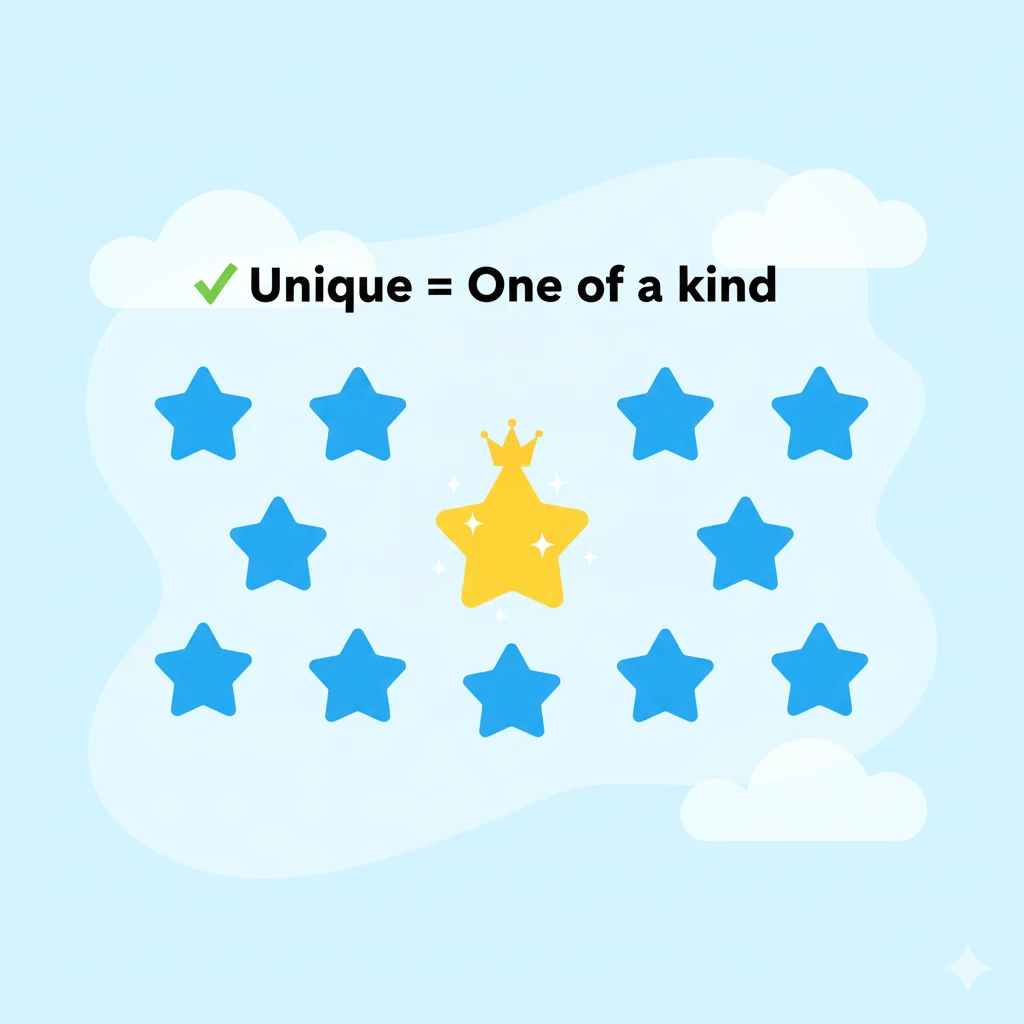
The word unique means one of a kind.
It means something special that is not like anything else.
Simple meaning:
👉 Only one
👉 Very special
👉 Different from everything else
Examples:
- Every person has a unique fingerprint.
- She has a unique way of painting pictures.
- That old coin is unique and very rare.
Part of speech:
Unique is an adjective.
It describes a noun (a person, place, or thing).
What Does “A” Mean?
A is an article.
We use a before singular nouns when we talk about something for the first time.
Important rule:
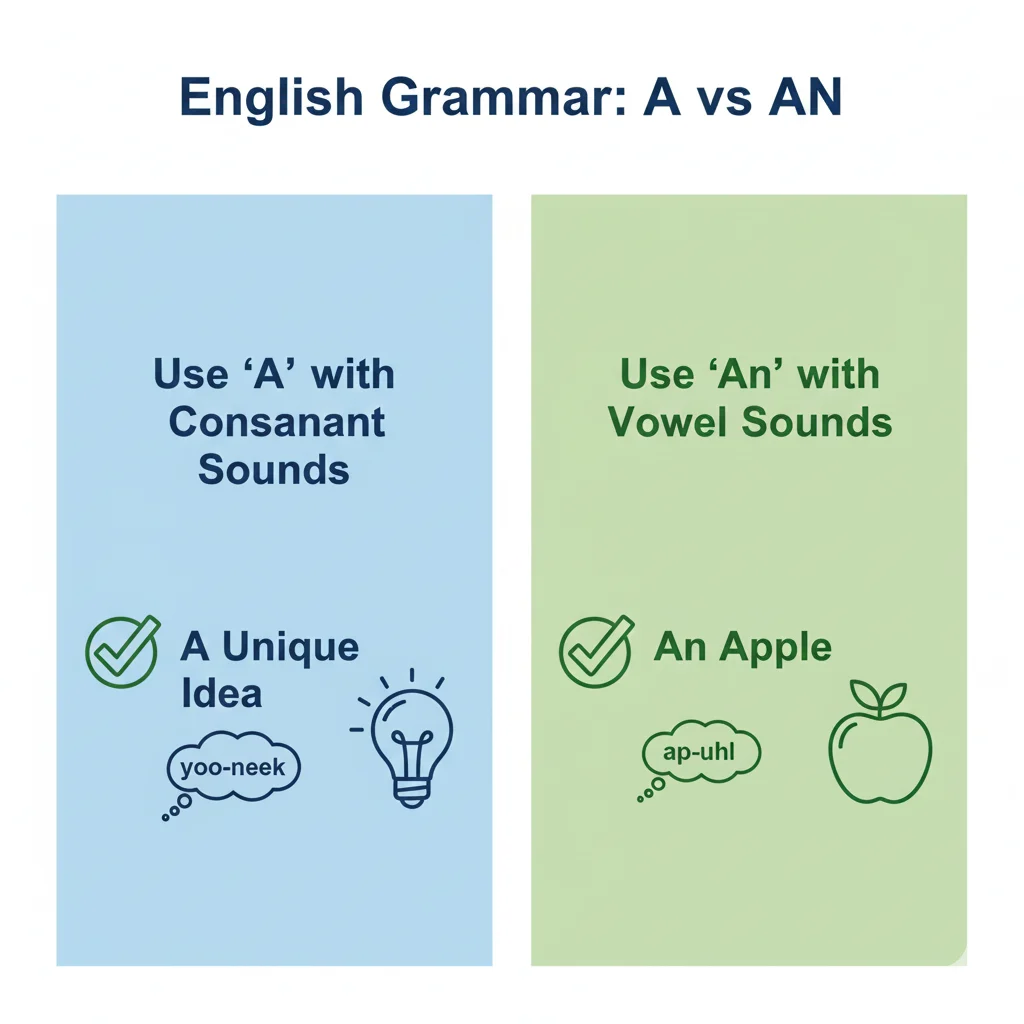
👉 Use a before words that start with a consonant sound.
Examples:
- a cat
- a book
- a house
- a unique idea
What Does “An” Mean?
An is also an article.
It has the same job as a, but it is used differently.
Important rule:
👉 Use an before words that start with a vowel sound.
Vowel sounds come from:
A, E, I, O, U (sounds, not letters)
Examples:
- an apple
- an egg
- an ice cream
- an hour (silent “h”)
The Key Difference Between An Unique and A Unique
Now let’s answer the big question.
✅ Which one is correct?
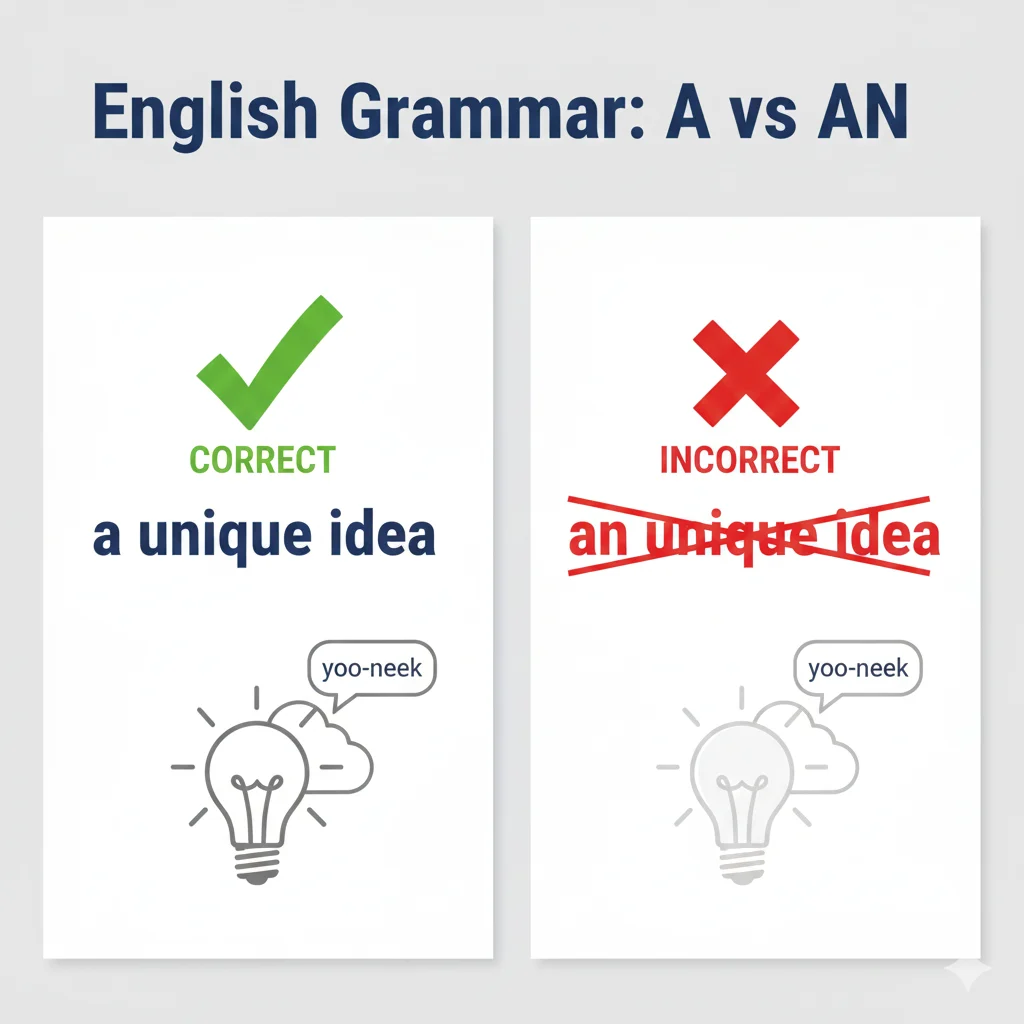
✔ A unique — Correct
❌ An unique — Incorrect
Why “A Unique” Is Correct
Even though unique starts with the letter U, it does not start with a vowel sound.
The word unique sounds like:
👉 “yoo-neek”
That “yoo” sound is a consonant sound, not a vowel sound.
So, we use a, not an.
Simple Rule to Remember
👉 English articles depend on sound, not spelling.
If the word starts with a vowel sound, use an.
If the word starts with a consonant sound, use a.
Comparison Table: An Unique vs A Unique
| Feature | A Unique | An Unique |
|---|---|---|
| Correct usage | ✅ Yes | ❌ No |
| Grammar rule | Consonant sound (“yoo”) | Incorrect vowel assumption |
| Spoken English | Natural and correct | Sounds wrong |
| Written English | Standard | Grammar mistake |
| Example | A unique idea | ❌ An unique idea |
Quick Tip:
If the word sounds like it starts with Y, use a.
Common Mistakes and How to Avoid Them
Many learners make mistakes with an unique or a unique because they focus on letters, not sounds.
❌ Common Mistake 1
An unique opportunity
✅ Correct sentence:
A unique opportunity
Why it’s wrong:
Unique starts with a “yoo” sound.
❌ Common Mistake 2
She has an unique talent
✅ Correct sentence:
She has a unique talent
Why it happens:
The letter U tricks learners.
❌ Common Mistake 3
This is an unique idea
✅ Correct sentence:
This is a unique idea
How to fix it:
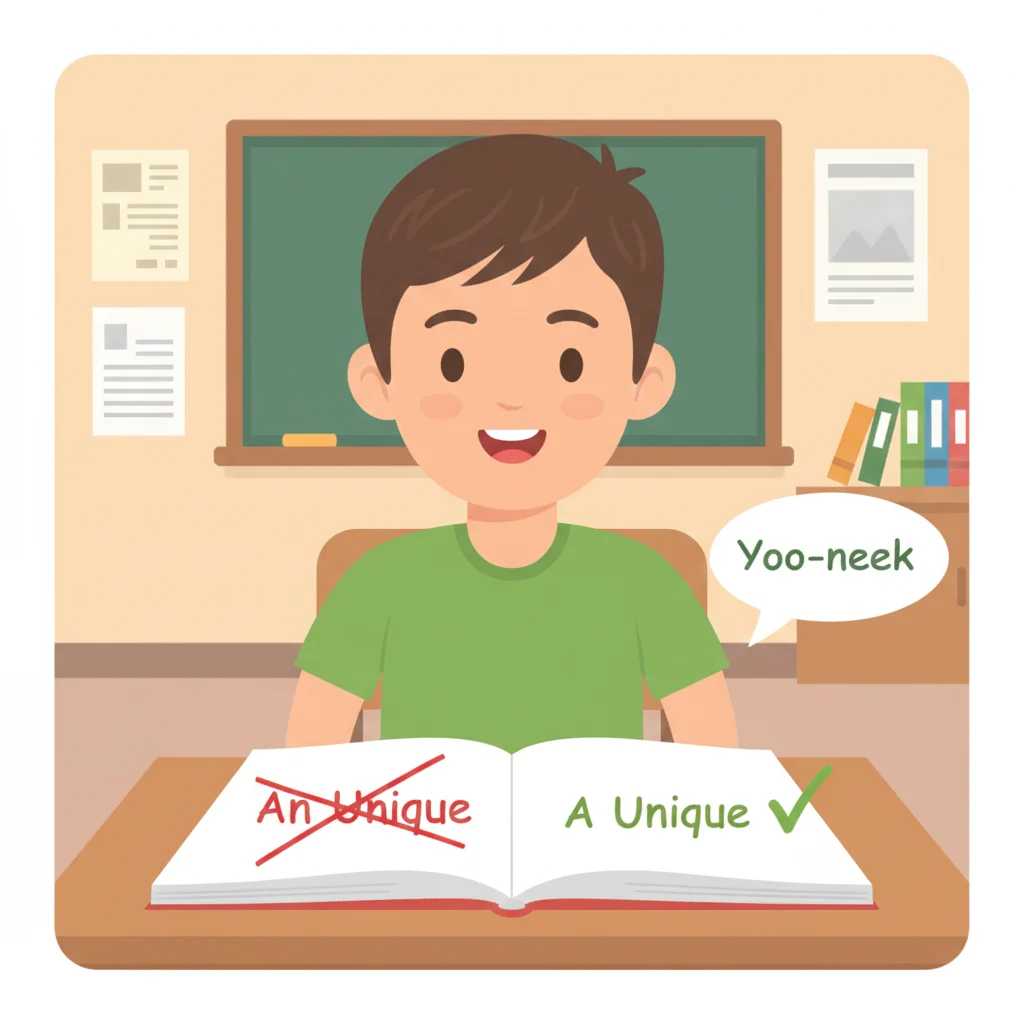
Say the word out loud.
If it starts with “yoo,” use a.
When to Use A Unique
Use a unique whenever you describe one special thing that starts with the “yoo” sound.
Situations to Use “A Unique”
- Talking about ideas
- Describing people
- Writing school essays
- Speaking in daily life
- Writing stories or emails
Easy Examples
- She had a unique plan for the project.
- That bird has a unique color.
- This shop sells a unique product.
- He has a unique voice.
- Our school has a unique tradition.
Real-Life Example (Story)
Tom found a shell on the beach.
It looked different from all others.
His teacher said,
“That is a unique shell. Keep it safe!”
When to Use An (But Not With Unique)
Let’s be clear: an is useful, just not with unique.
Use An When the Word Starts With a Vowel Sound
Correct examples:
- an apple
- an orange
- an umbrella
- an hour
- an honest man
Compare These Sounds
- Unique → yoo-neek → a unique
- Umbrella → um-brella → an umbrella
Memory Hack 🧠
👉 If you hear “yoo”, use a
👉 If you hear “uh,” “ah,” “eh,” “oh,” “ih”, use an
Say it out loud. Your ears will help you.
Quick Recap: An Unique vs A Unique
- Unique means one of a kind
- It starts with a “yoo” sound
- Use a, not an
- A unique is correct
- An unique is always wrong
Advanced Tips (Optional but Helpful)
Word Origin
The word unique comes from Latin unicus, meaning one.
It has always meant something special and single.
Use in Exams and Formal Writing
In exams, essays, and professional writing:
- Always write a unique
- Writing an unique can lower your score
Texting and Online Writing
Many people type an unique online.
This is still incorrect.
Bad grammar can change meaning and reduce clarity.
Mini Quiz: Test Yourself ✏️
Fill in the blanks with a or an.
- She has ___ unique style.
- This is ___ umbrella.
- He gave me ___ honest answer.
- That is ___ unique gift.
- I saw ___ apple on the table.
- We heard ___ unusual sound.
Answers
- a unique
- an umbrella
- an honest
- a unique
- an apple
- an unusual
FAQs: An Unique or A Unique
1. Is “an unique” ever correct?
No. An unique is always incorrect in standard English.
2. Why do people say “an unique”?
Because they focus on the letter U, not the sound.
3. What is the correct phrase?
The correct phrase is a unique.
4. Does this rule apply to other words?
Yes. Words like university and unit also use a.
5. How can I avoid this mistake?
Say the word out loud and listen to the first sound
Conclusion
Now you know the clear difference between an unique or a unique. The correct choice is always a unique because English articles depend on sound, not spelling. The word unique starts with a “yoo” sound, which is a consonant sound. That is why an unique is wrong.
By learning this simple rule, you can improve your English writing, speaking, and exam scores. Practice using a unique in daily sentences, and soon it will feel natural. English becomes easier when you understand the logic behind it. Keep learning, keep practicing, and enjoy improving your language skills every day.
Dorothy Whipple was an English novelist and short story writer, famed for emotional realism, domestic themes, and sharp insight into women’s lives. worldwide UK